


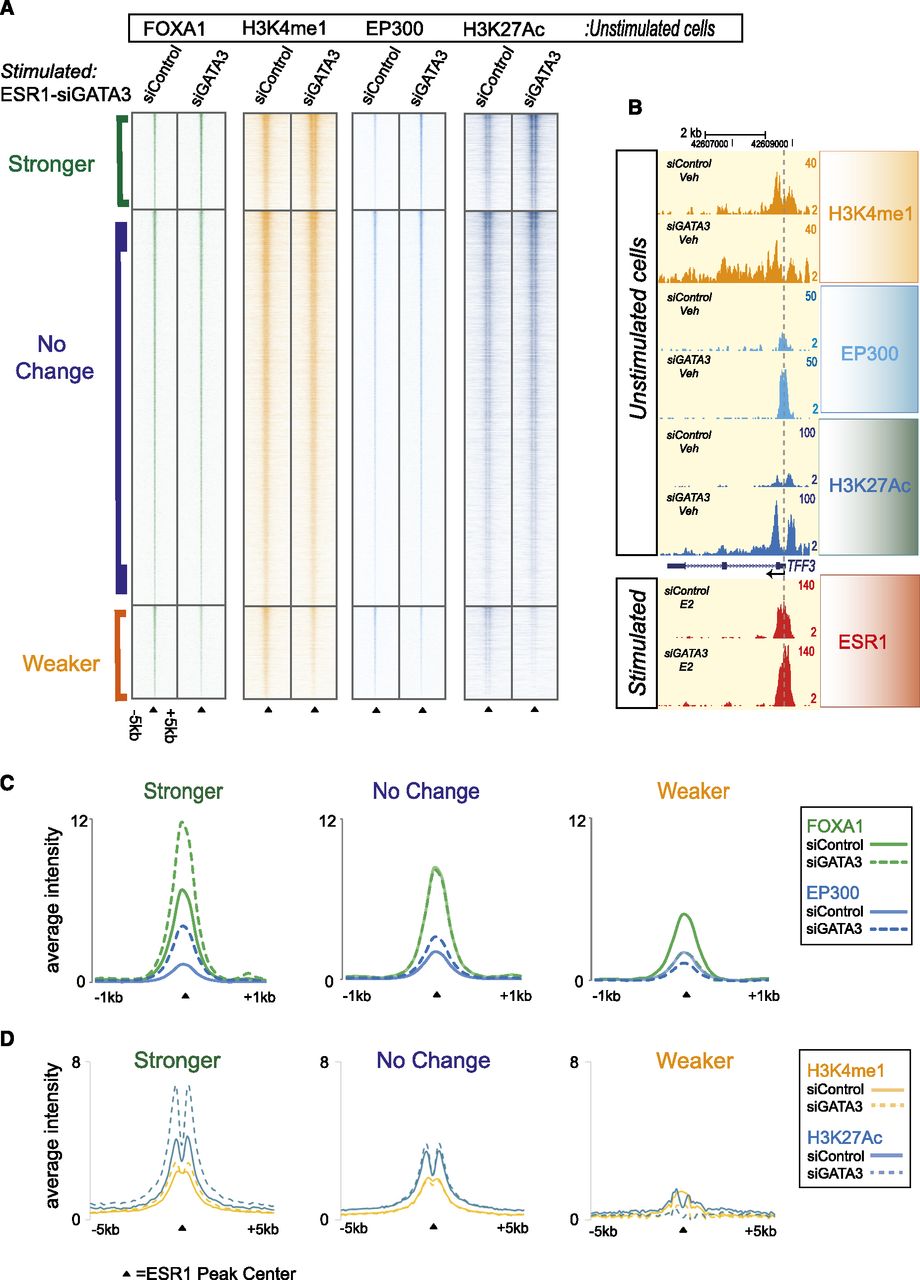
Silencing GATA3 modulates enhancer accessibility by redirecting FOXA1, EP300, H3K4me1, and H3K27Ac histone marks prior to ESR1-E2 recruitment. (A) FOXA1, EP300, H3K4me1, and H3K27Ac were mapped by ChIP-seq, following silencing of GATA3 or siControl. Silencing of GATA3 results in an altered histone profile at enhancer elements prior to ESR1 recruitment (Veh) at the same regions that will harbor the redistributed ESR1 binding upon E2 stimulation. (B) An example of the changes in the histone landscape and EP300 recruitment at TFF3, an E2 up-regulated gene. Silencing of GATA3 results in a gain of H3K4me1, EP300, and subsequent H3K27Ac in unstimulated cells, which parallels the E2-dependent gain in ESR1-binding affinity. (C) Average ChIP-seq signal intensity of FOXA1 and EP300 binding in unstimulated (Veh) MCF7-siGATA3 and siControl cells, centered on the redistributed ESR1-siGATA3 events. (D) Average ChIP-seq signal intensity of H3K4me1 and K3K27Ac binding in unstimulated (Veh) MCF7-siGATA3 and siControl cells, centered on the redistributed ESR1–siGATA3 events.



