


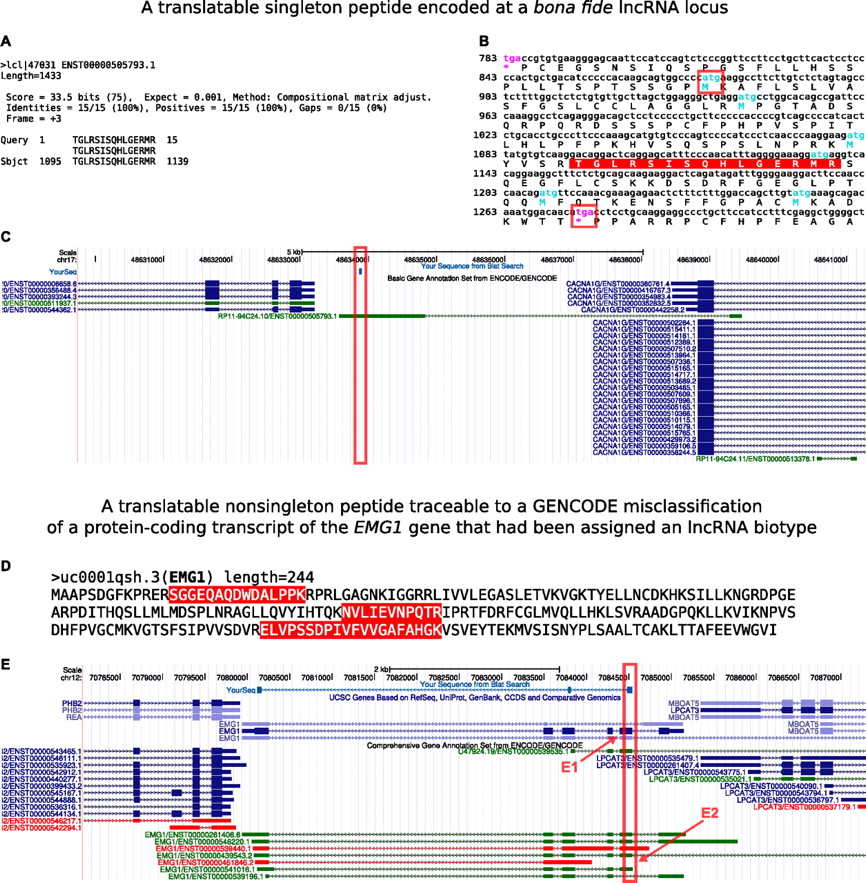
Manual annotation of translatable peptides aligning to GENCODE lncRNA exons: case studies. (A–C) A translatable singleton peptide encoded at a bona fide lncRNA locus. (A) BL2SEQ TBLASTN peptide-to-lncRNA alignment. (B) NCBI ORF Finder view of the translation containing this peptide (highlighted) including its furthest upstream ATG and its downstream stop (red rectangles). (C) UCSC Genome Browser view of the peptide (red box). Direction is negative strand. The singleton peptide is encoded by exon 2 of a GENCODE lncRNA that is divergently transcribed in the antisense orientation relative to the known gene CACNA1G. (D,E) A translatable non-singleton peptide traceable to a GENCODE misclassification of a protein-coding transcript of the EMG1 gene that had been assigned an lncRNA biotype. (D) Three peptides (red) that are in-frame to the EMG1 known protein (full-length shown) but are assigned to the GENCODE lncRNA ENST00000439543.2. (E) UCSC Genome Browser view of the peptide (red box). Direction is positive strand. The lncRNA is a noncoding transcript from the coding EMG1 locus. However, the peptides correspond to known coding exons of the EMG1 RefSeq, not solely to exons of the noncoding transcript. (E1) Peptide matches the common coding mRNA exon, not a unique exon of the lncRNA (this is true in all cases). (E2) GENCODE v7 lncRNA match.



