


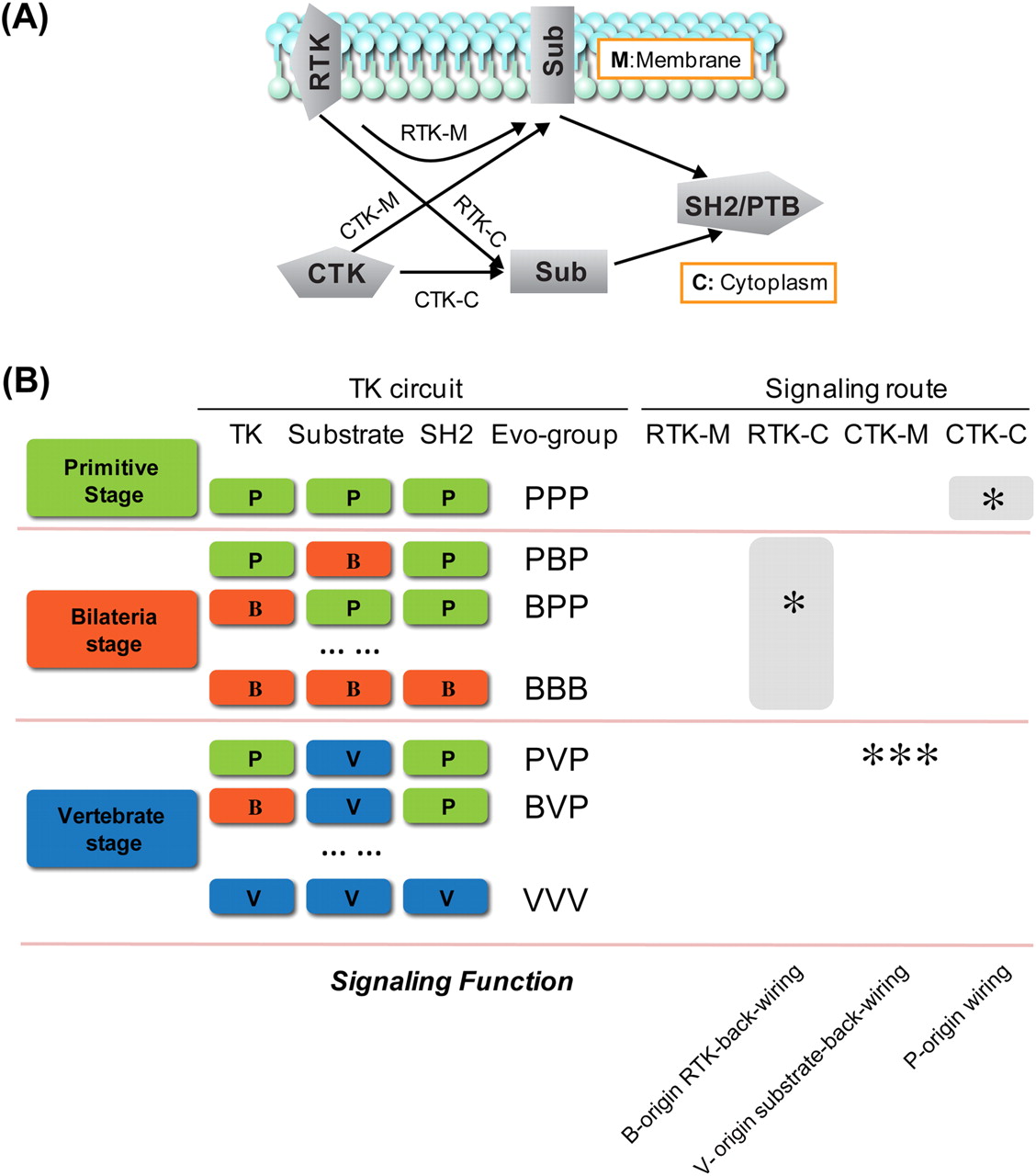
Evolutionary origins of tyrosine kinase (TK) circuits and signaling routes. (A) A diagram depicting the signaling routes for intracellular, inter- or extracellular, and tissue-specific communication via the TK circuits. A kinase or substrate may be a membranous or cytoplasmic protein. Depending on cellular locations of its components, a TK circuit may belong to one of the four signaling routes, namely, RTK-M, RTK-C, CTK-M, and CTK-C, where M and C denote membrane and cytoplasm, respectively. (B) Enrichment of different signaling routes at distinct evolutionary stages. TK circuits were divided into “evo-groups” according to the origins of the corresponding circuit components. The evo-group is used to assign the origin of a signaling route. The enrichment of a particular evo-group circuit in a signaling route provides information on the evolutionary origin of the latter. TK circuits of a particular origin that are enriched (P < 0.05) in a signaling route for both curated and predicted data sets were identified by gray rectangles with the significantly enriched evo-group identified by asterisks. Intracellular signaling (represented by the CTK-C signaling route) is significantly enriched with the PPP evo-group circuits (via the P-origin self-wiring path). Extracellular or intercellular signaling (represented by the RTK-C route) is significantly enriched with the BPP evo-group circuits in which newly evolved (B-origin) TKs “wire back” to ancient (P-origin) substrates (via the B-origin RTK-back-wiring path). In contrast, tissue-specific CTK-M signaling is enriched with PVP circuits that feature vertebrate-origin substrate wiring-back to ancient (P-origin) TKs and SH2 domain-containing proteins (via the V-origin substrate-back-wiring path). (*) P < 0.05; (***) P < 0.001, randomization test.


