


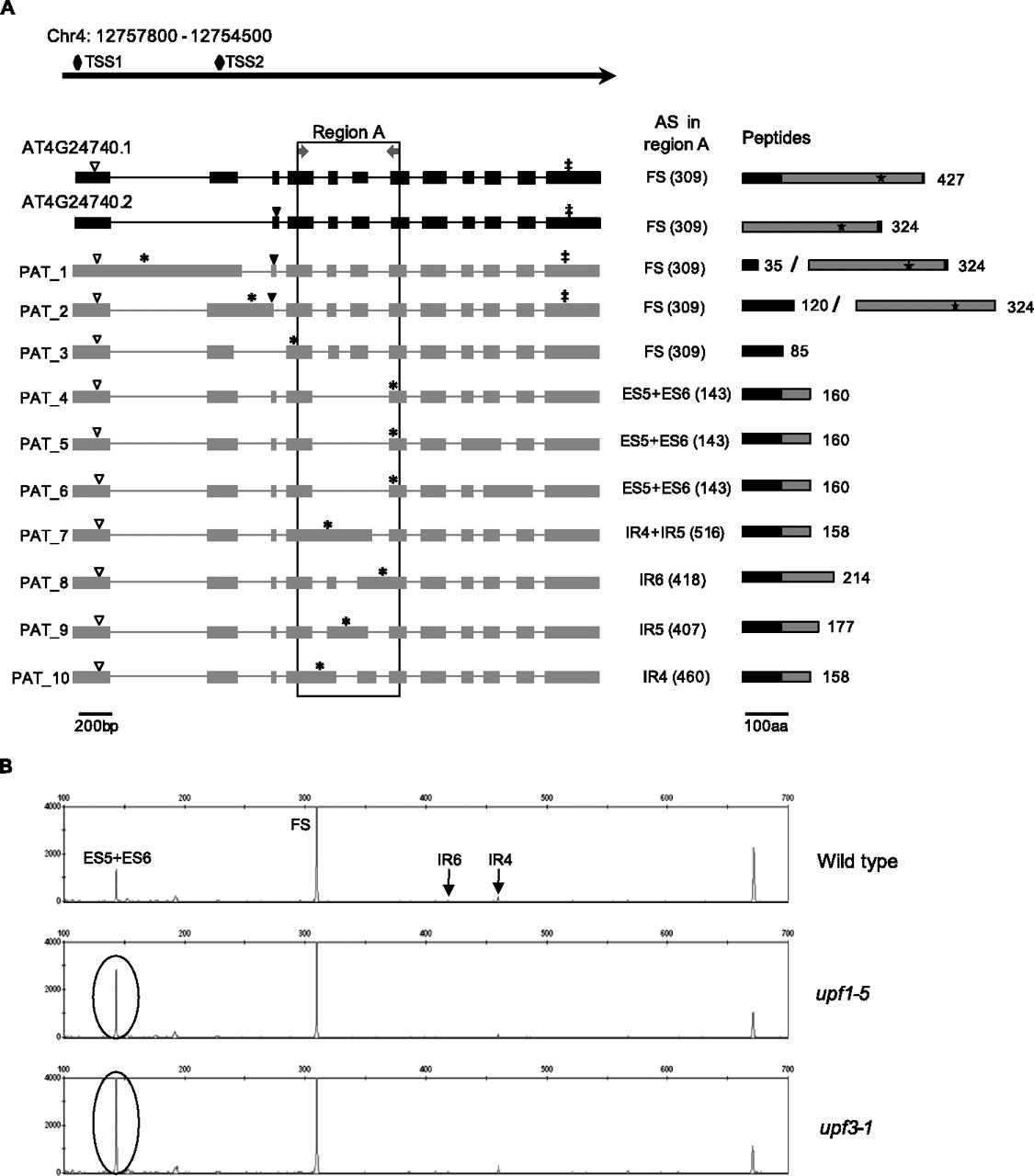
Alternative splicing in the AFC2 gene. (A) The black arrow represents the chromosome location of AFC2 and its orientation indicates the direction of transcription. (Diamonds) Two transcription start sites (TSS) reported by TAIR. (Black) TAIR models for the AFC2 gene; (gray) new putative assembled transcripts (PATs). The triangles located over the TAIR transcripts and PATs indicate the start codons, while the asterisks or double daggers represent the stop codons. For PAT1 and PAT2, two putative start codons (full and empty triangles) and two putative stop codons (asterisk and double dagger) are depicted. Protein isoforms predicted using the shown start and stop codons are illustrated at the end of each splice variant followed by their sizes in amino acids. (Black) Noncatalytic domain; (gray) kinase catalytic domain. (Star) Location of the LAMMER motif. (Arrows) The primer pair 226 designed for the HR RT-PCR panel. The amplified region is highlighted by a box (region A). The AS events in the region A are shown after each transcript, and the number in parentheses denotes the size of the amplified product in nucleotides. Abbreviations for AS events: (FS) fully spliced, (IRn) intron retention where “n” is the number of the intron, (ESn) exon skipping of exon number “n.” (B) Electropherograms of RT-PCR products for the primer pair indicated in A for wild type and upf mutants generated by GeneMapper. Numbers on the x-axis represent the size markers in bp; numbers on the y-axis represent relative fluorescence, reflecting transcript abundance. The AS event associated with each product is shown in the respective peak. (Ovals) The peaks which increase in abundance in the upf1-5 and upf3-1 mutants.



