


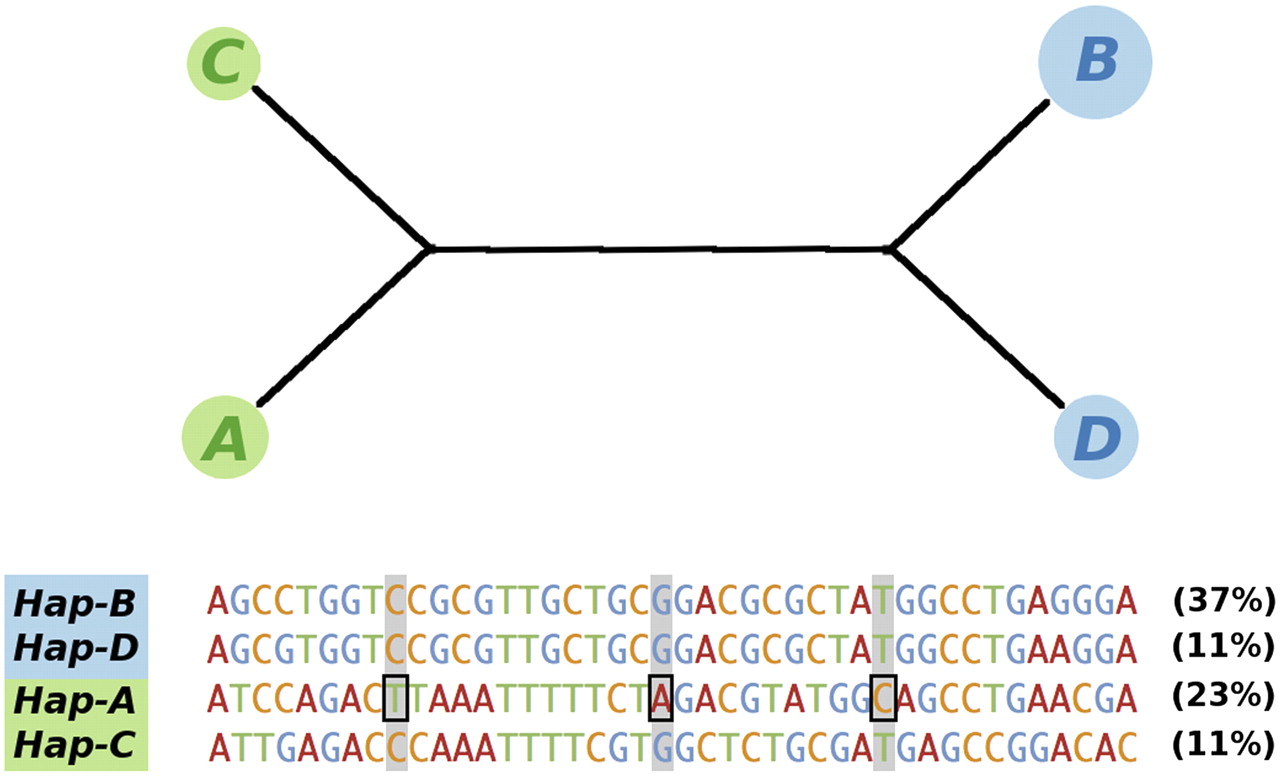
Median-joining network representing phased HapMap CEU haplotypes influencing BLK-FAM167A mRNA levels. The network was constructed using 42 SNPs (Supplemental Table S5C) mapping to chr8:11,376,782–11,393,411 phased in 45 samples; 8p23-inv heterozygotes were omitted to minimize phasing-induced errors, as were haplotypes with frequencies ≤2%. Haplotype groups are denoted by circles (with circle size proportional to haplotype frequency) and colored by whether the haplotypes derive from II (blue) or NN (green) samples. Haplotype groups are named “A–D,” corresponding with previous nomenclature (Ge et al. 2009). Distances between nodes are proportional to the number of differences distinguishing each haplotype; actual haplotypes (and their frequencies in CEU founders) are provided below the network. Risk alleles for systemic lupus erythematosus and rheumatoid arthritis identified in four GWAS are highlighted (rs2736340, rs13277113, rs2618476) (Graham et al. 2008; Hom et al. 2008; Gregersen et al. 2009; Chung et al. 2011).


