


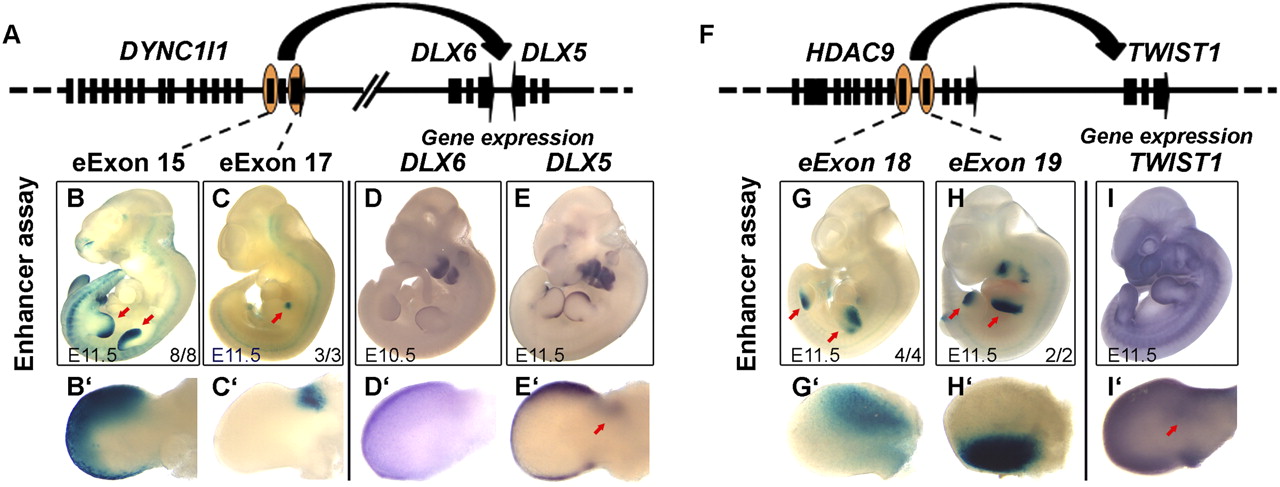
eExons within DYNC1I1 and HDAC9 characterized using a mouse transgenic enhancer assay. A schematic of the DYNC1I1-DLX5/6 (A) and HDAC9-TWIST1 (F) genomic regions. Black boxes and orange ovals represent coding exons and positive eExons, respectively. The black arrows point to the genes that are thought to be regulated by the eExons. (B–C′) Mouse enhancer assays of DYNC1I1 eExon 15 and 17 at embryonic day 11.5 (E11.5). (B,B′) DYNC1I1 eExon 15 shows apical ectodermal ridge (AER) and limb mesenchyme enhancer activity (red arrows), and (C,C′) DYNC1I1eExon 17 shows anterior limb bud mesenchyme enhancer activity (red arrow). (D,E) Mouse whole-mount in situ hybridization of Dlx6 and Dlx5. (D′,E′) Dlx6 and Dlx5 limb expression pattern is similar to DYNC1I1 eExon 15 enhancer activity. In addition, Dlx5 is also expressed in anterior limb bud as depicted by the red arrow (E′), similar to DYNC1I1 eExon 17 enhancer activity (C′). (G–H′) Mouse enhancer assays of HDAC9 eExons 18 and 19. (G,G′) HDAC9 eExon 18 shows anterior limb bud enhancer activity (red arrows), and (H,H′) HDAC9 eExon 19 shows posterior limb bud (red arrows) and branchial arch enhancer activity in E11.5 mice. (I) Mouse whole-mount in situ hybridization of Twist1 at E11.5. (I′) Twist1 limb expression pattern is similar to the HDAC9 eExon 18 anterior limb bud enhancer activity (G′) marked by red arrow and HDAC9 eExon 19 posterior limb bud enhancer activity (H′). For B, C, G, and H, the numbers in the bottom right corner indicate the number of embryos showing this limb expression pattern/total LacZ stained embryos.



