


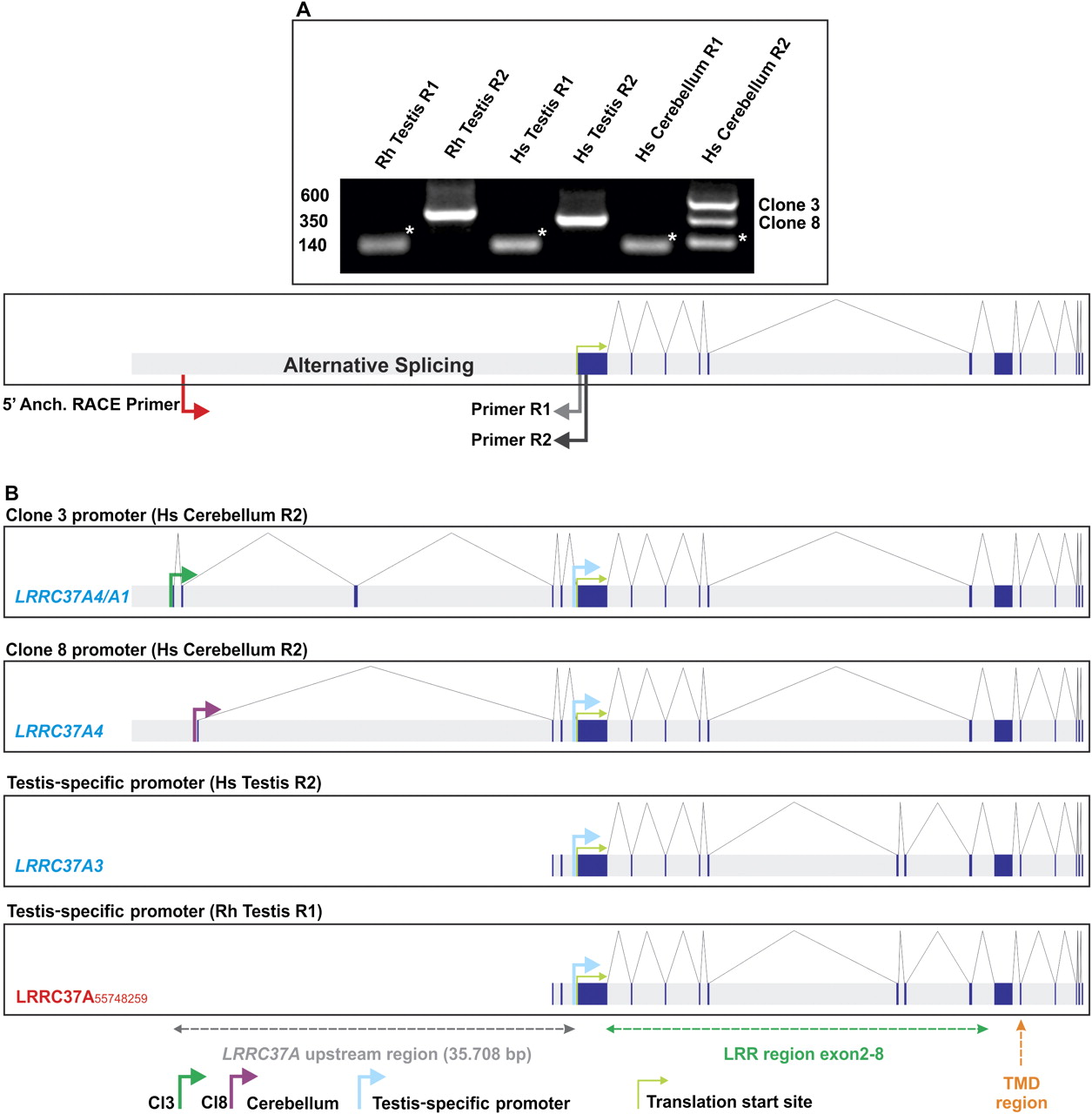
Identification of LRRC37 promoter regions in human and macaque. (A) RACE-PCR analysis on the cDNA isolated from the total RNA extracted from human [(Hs) Homo sapiens] and macaque [(Rh) Macaca mulatta] by using testis and cerebellum tissues. Two sets of primer pairs specific for macaque (Rh) and human (Hs) were used for final nested PCR amplification, Rh testis R1 and R2, Hs testis R1 and R2, and Hs cerebellum R1 and R2, respectively. Three PCR products were observed, cloned, and subsequently sequenced. (*) A PCR band for nonspecific amplification. (B) Schematic representation of RACE-PCR transcripts embedded on the structure of the detected LRRC37 gene structure after sequencing analysis. Promoter regions for corresponding transcripts (cerebellum clone 3 [Cl3] and cerebellum clone 8 [Cl8]) and testis-specific promoter (T1) from human (Hs Testis R2) and macaque (Rh Testis R2). (Orange arrow) The transmembrane domain (TMD).



