


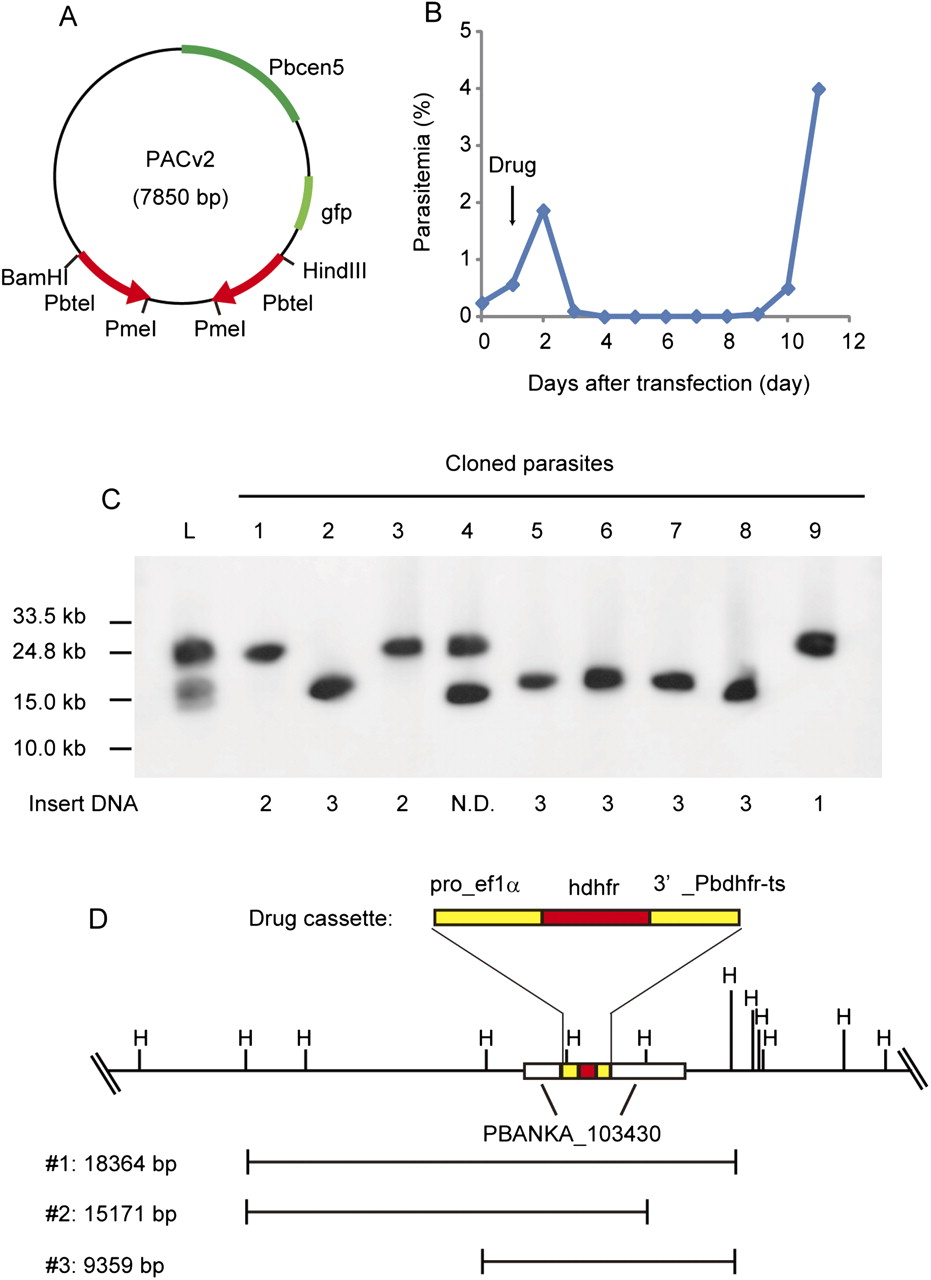
The identification of a drug-resistance gene from a PAC library by drug screening. (A) A schematic drawing of PACv2. (B) Parasites were transfected with the PACv2 library, which was made from the genomic DNA of the artificial drug-resistant parasite. The parasitemia was monitored every 24 h after transfection. (Arrow) Initiation of the drug treatment of the parasites. (C) Southern blot analysis of PACv2 (including DNA fragments) was performed using the hdhfr gene as the probe. (Lane L) PACv2 library in the total population of the transfected parasites. (Lanes 1–9) Cloned drug-resistant parasites. The inserted DNA fragments in PACv2 from each clone are numbered according to Figure 4D, as shown on the bottom. (D) A schematic drawing of the inserted DNA fragments 1–3 in PACv2 from the selected drug-resistant parasites. (Left) Lengths of the DNA. (Top) Genomic sequence surrounding PBANKA_103430, with the HindIII recognition sites.



