


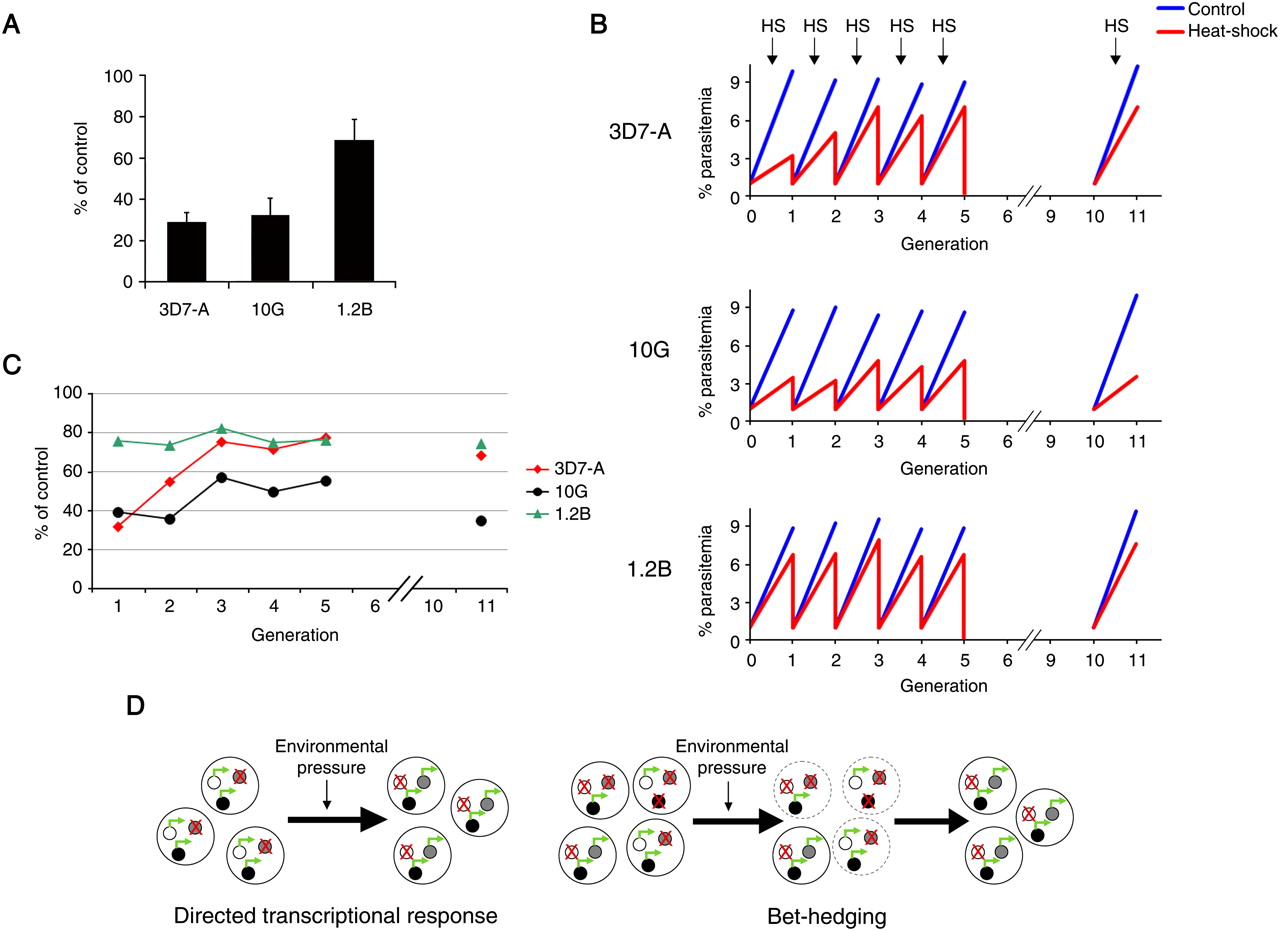
Adaptation to heat-shock. (A) Inhibition of parasite growth by a 3-h heat-shock at 41.5°C. Values are the average of three independent experiments, with standard deviation, and represent percentage of growth relative to identical cultures not subjected to heat-shock. Heat-shock was performed when parasites were at the trophozoite stage, and parasitemia was measured by FACS at the next generation. (B) Growth under periodic heat-shock. Parasites at the trophozoite stage were subjected to heat-shock for five consecutive generations. After each cycle, heat-shocked cultures were synchronized, adjusted to 1% parasitemia, and split into two identical dishes to compare again growth between heat-shock and control conditions. Cultures were grown without heat-shock in cycles 6–10. For details, see Supplemental Methods. (C) Percentage of growth under heat-shock relative to normal conditions, calculated from the data in panel B. (D) Schematic model for adaptation through directed transcriptional responses and adaptation through spontaneous clonally variant gene expression (bet-hedging). (Small circles) Individual genes that can be either repressed (crossed) or active (green arrow). In the directed transcriptional response scenario, a change in the environment results in an immediate protective transcriptional response, such that the external change is sensed, and specific genes are activated or repressed to mediate adaptation to the new conditions. In contrast, in the bet-hedging scenario, the population is transcriptionally heterogeneous as a consequence of spontaneous clonally variant gene expression. Upon a change in the environment, pre-existing parasites with combinations of expressed and repressed genes that confer fitness under the new conditions are selected and survive, whereas other parasites die (broken line).



