


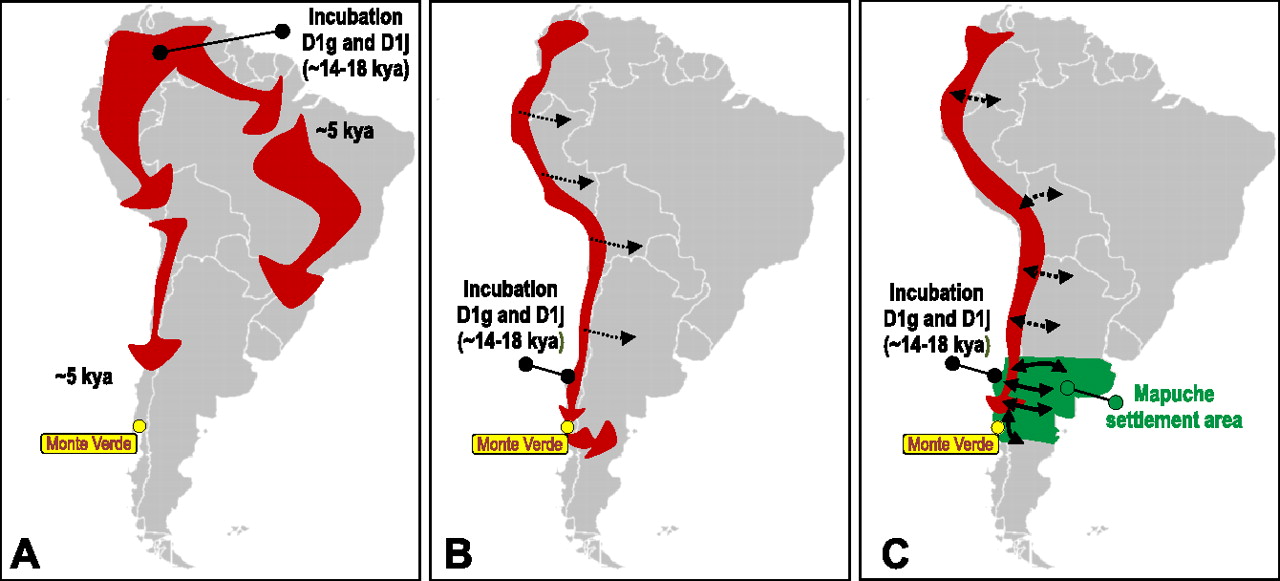
Migration models into the South American continent. The three migration models discussed are illustrated along with a timing of events resulting from our calculations: the incubation of population groups arriving from the north in a northern area of South America and a late split into coastal and continental population groups after the full development of all major D1g and D1j subclades (A); a coastal southward migration followed by the colonization of the continental interior by trans-Andean migrations, with limited later exchange along the cordillera (B); and a coastal southward migration and trans-Andean colonization of the continental interior, followed by extensive trans-Andean migrations, especially in the south, with the Mapuches favoring bidirectional gene flow between west and east in the Southern Cone (C). The latter is the most likely model from our results.



