


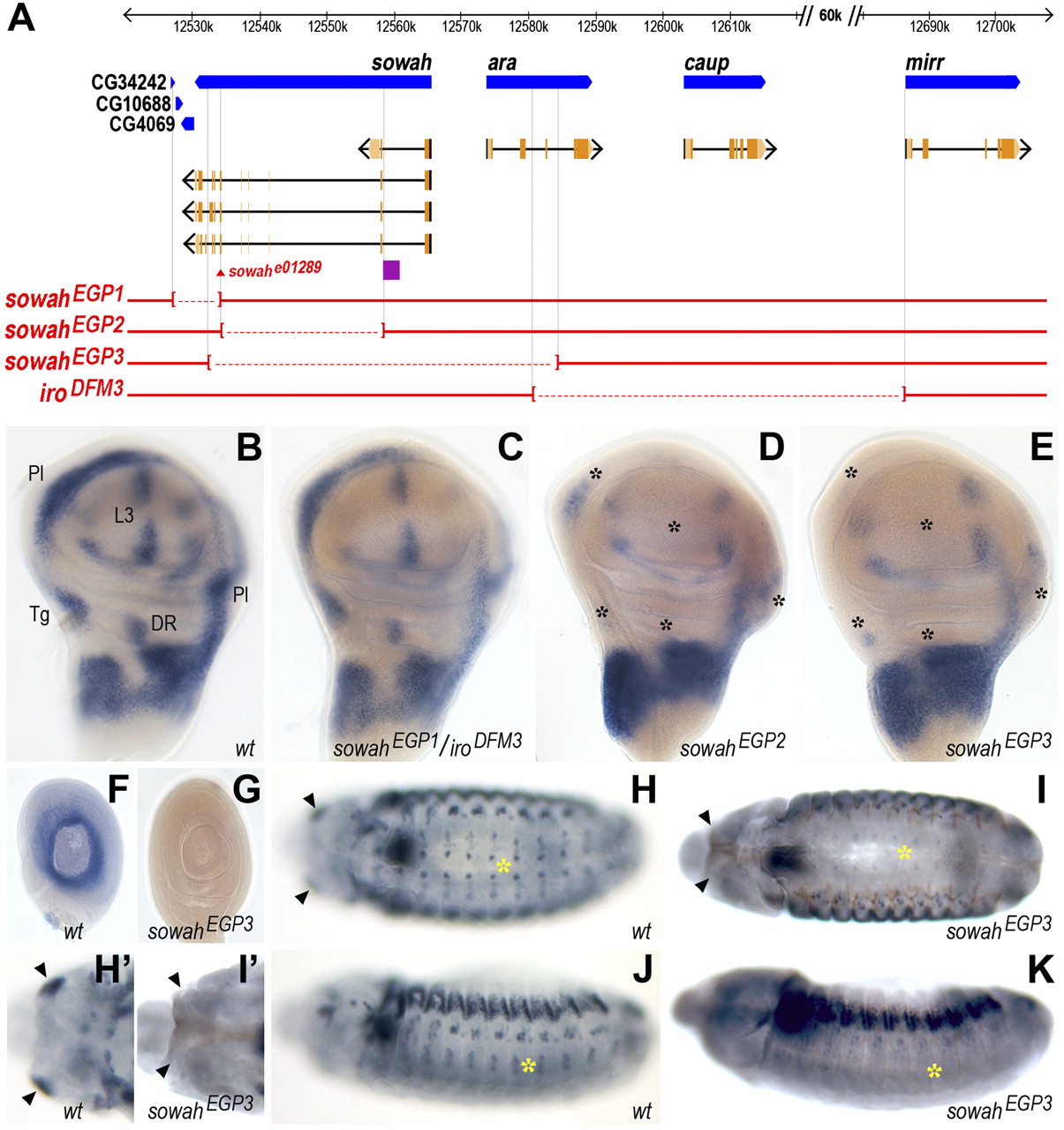
Expression of caup in sowahEGP imaginal discs and embryos. (A) Physical map of the Iro-C locus. Genomic DNA is shown as a thick black bar with a 60-kb gap delimited by //. Transcripts are shown as black arrows below the genes (blue). Exons are shown in orange, with protein-coding regions colored darker. Red broken lines within brackets represent deleted regions. The purple box represents a region bound by several transcription factors as determined by ChIP-on-chip assays. (B–G) In situ hybridization with a caup probe of wing (B–E) and leg (F,G) discs of the indicated genotype. caup expression is not affected in the trans-heterozygous combination of sowahEGP1 and iroDFM3, used to rescue the early embryonic lethality of sowahEGP1. In sowahEGP2 (D) and sowahEGP3 (E) discs, caup expression is absent in L3 and DR domains and strongly reduced in Pl and Tg regions (marked with black asterisks). (G) sowahEGP3 leg disc, in which caup wild-type expression in a ring-like pattern (F) is lost. (H–K) Anti-Caup staining of wild-type (H,H',J) and sowahEGP3 (I,I',K) late-stage 13 embryos. Yellow asterisks mark the expression of ara/caup in the nervous system; arrowheads point to the head mandibular segment. The brown signal in I corresponds to a nonspecific staining of the tracheal (respiratory) system. (H,I) ventral, (J,K) lateral views, (H',I') enlarged views of the head.



