


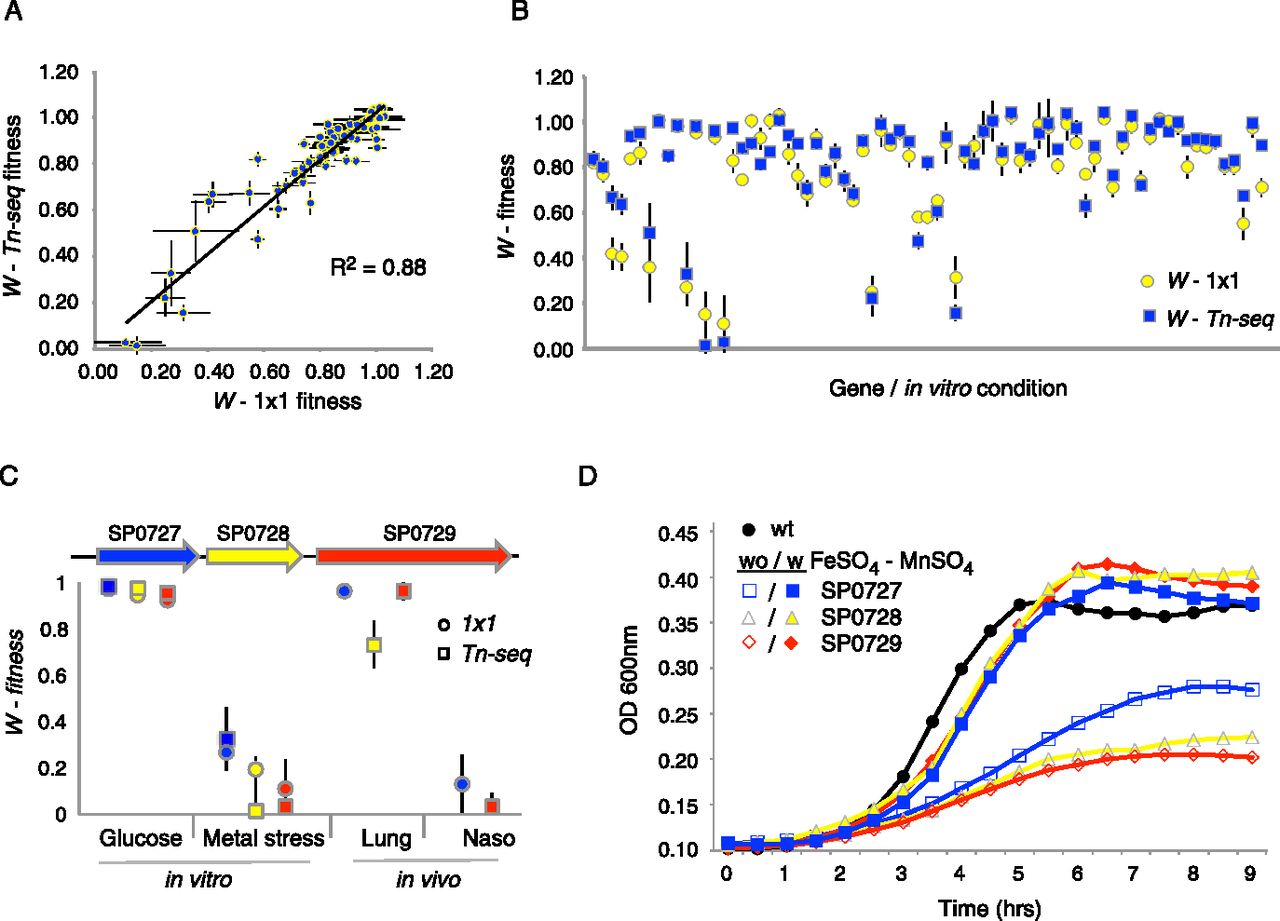
Tn-seq fitness strongly correlates with traditional 1 × 1 competition experiments, and overlapping in vitro condition-specific fitness with in vivo disease state-specific fitness provides leads toward in vivo selection pressures. (A) Correlation between Tn-seq fitness and 1 × 1 fitness, where a single deletion mutant is competed against the wild type (n = 75, shown are average ± SEM). Each competition was done at least four times, while each Tn-seq fitness value was calculated from at least three independent insertions. (B) No significant differences were found between Tn-seq fitness and 25 deletion mutants that were competed 1 × 1 in several different conditions against the wild type. (C) A strong overlap was found between the three genes SP0727–0729, their sensitivity for metal stress (depleted divalent cations), and their attenuation in the nasopharynx. According to both Tn-seq fitness and 1 × 1 fitness, none of the genes exhibit growth defects in glucose, while growth is severely attenuated in the presence of bipyridyl (metal stress; one-sample t-test with Bonferroni correction; P < 0.0001). In addition, according to Tn-seq fitness for SP0729 and 1 × 1 fitness for SP0727, the operon is important for growth in the nasopharynx (P < 0.001), while Tn-seq fitness for SP0728 and SP0729 and 1 × 1 fitness for SP0727 show there is no defect in the lung. Tn-seq fitness could not be determined in the lung for SP0727 and for SP0727 and SP0728 in the nasopharynx due to a lack of insertions. (D) The growth defect of the three genes SP0727–0729 under metal stress (open symbols) is compensated for by adding 0.2 mM FeSO4 and MnSO4 (closed symbols). These data suggest that S. pneumoniae experiences metal imbalance of divalent cations in the nasopharynx, but not in the lung.


