


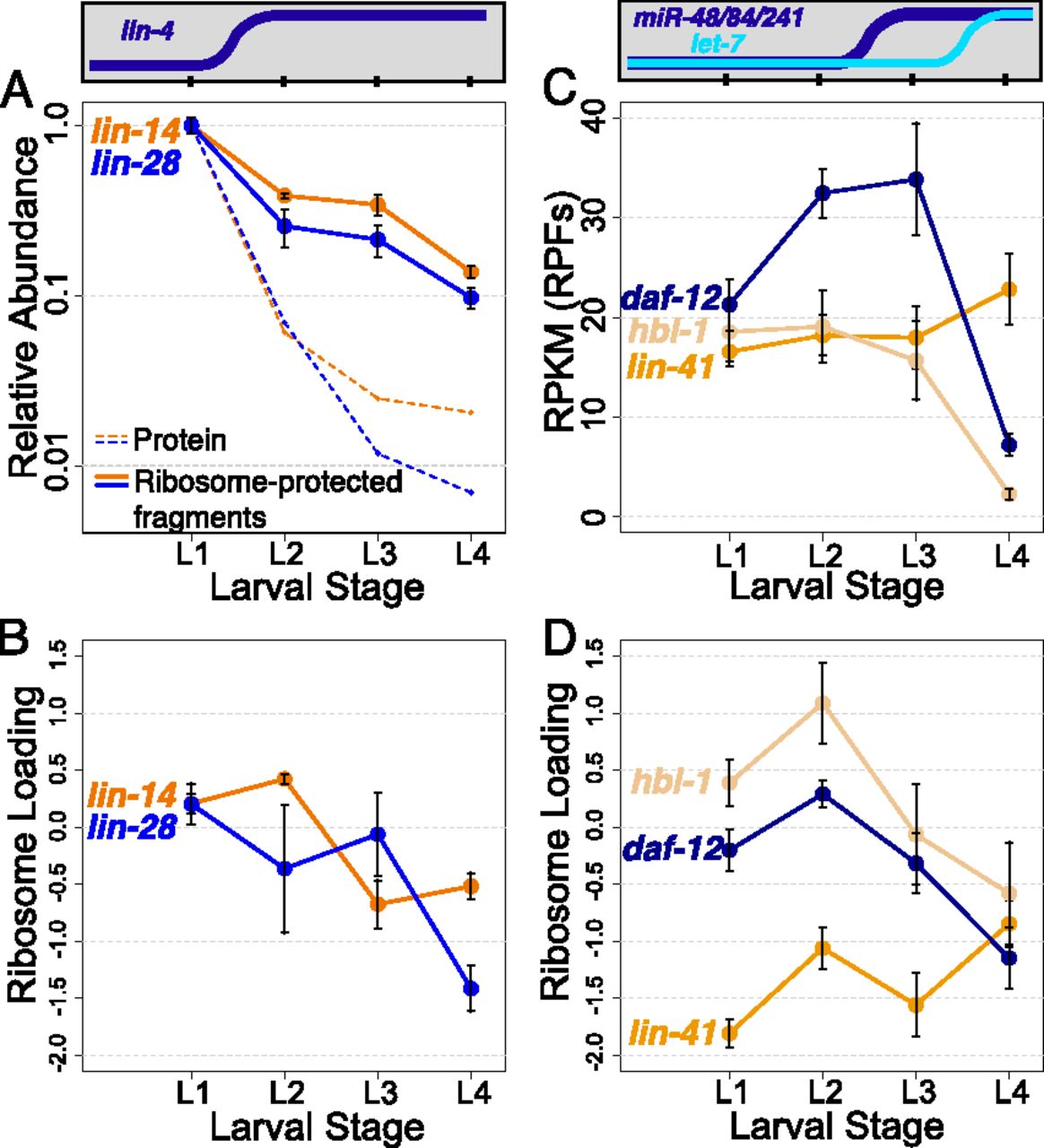
Changes in ribosome-protected fragment abundance and ribosome loading for heterochronic miRNA targets. Total RPF levels and ribosome loading at each larval stage are shown for lin-4 targets lin-14 and lin-28 (A–B) and let-7 family targets hbl-1, daf-12, and lin-41 (C–D). Count normalization and axis scaling are as in Figure 2, and protein levels are plotted for LIN-14 and LIN-28 as a reference (protein data are the same as in Fig. 2). Ribosome loading is defined as the log2 ratio of normalized counts from RPF libraries to corresponding mRNA-seq libraries. The significance of changes in RPF abundance across larval development (L1–L4) was determined by a two-sided t-test: lin-14 P = 0.003, lin-28 P = 0.01, lin-41 P = 0.29, hbl-1 P = 0.01, daf-12 P = 0.002. (Error bars) Standard error of the mean.



