


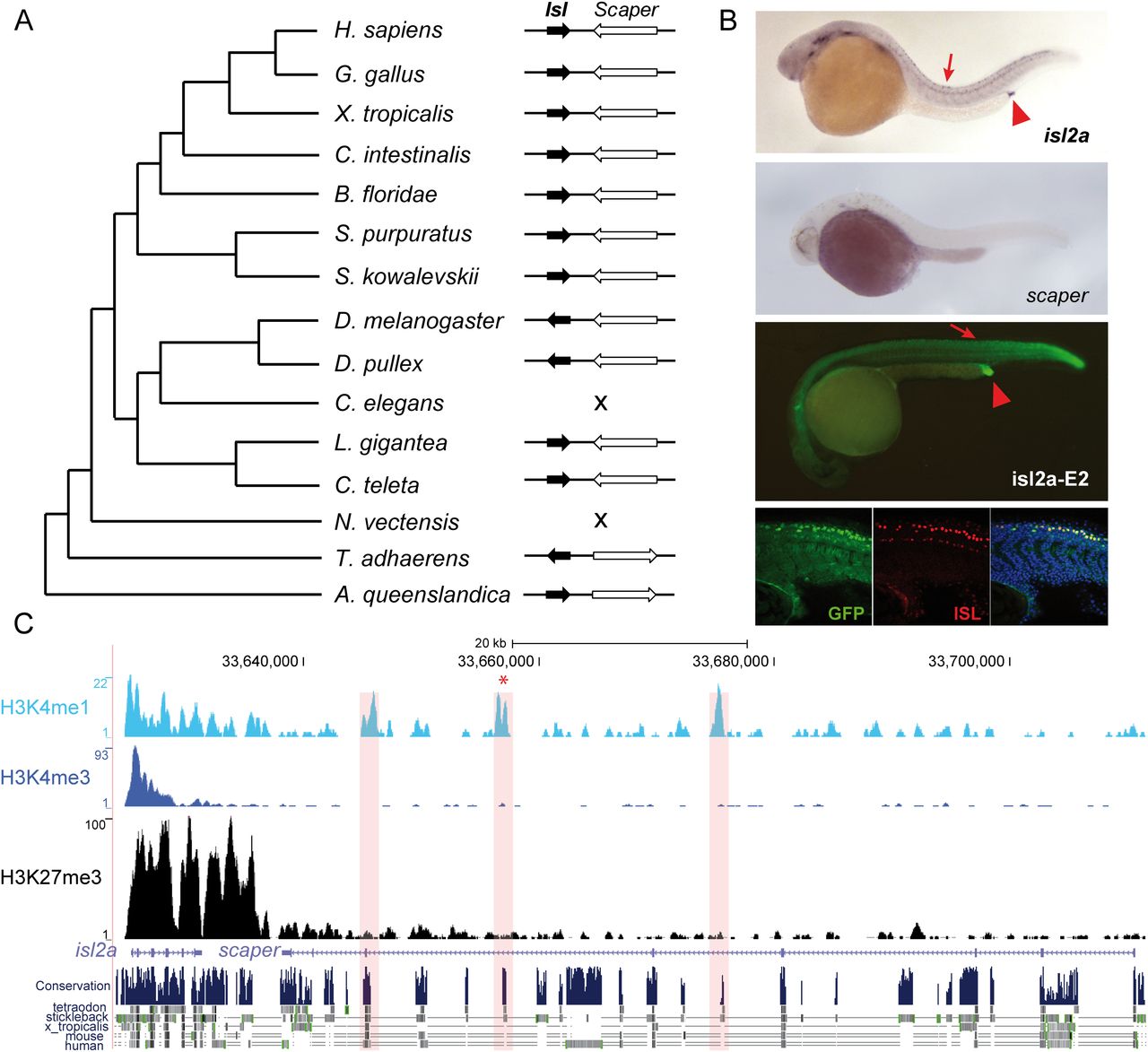
Functional characterization of the GRB of isl2a-scaper in zebrafish. (A) Phylogenetic distribution of the GRB across the studied metazoan species. The GRB was only not conserved in C. elegans and N. vectensis. (B) Top and middle panels are 24-h post fertilization (hpf) zebrafish embryos showing the expression patterns of isl2a and scaper. isl2a is expressed in discrete neurons in the spinal cord (arrow) and in the proctodeum (arrowhead), while scaper is not detectable at this stage. The third panel is an embryo at a similar developmental stage showing GFP expression promoted by an enhancer located within the intron of scaper (asterisk in C). This enhancer is active in isl2a-expressing territories. The bottom panel shows immunodetection of the transgenic GFP (green), the endogenous Islet proteins (red) and the overlay between the two showing coexpression. (C) Distribution of H3K4me3, H3K4me1, and H3K27me3 tracks along the isl2a-scaper GRB in 24-hpf zebrafish embryos. H3K4me1 peaks tested for enhancer activity in zebrafish stable transgenic lines are shaded in red. H3K4me3 and H3K27me3 distribution show that scaper is inactive and this stage and that isl2a is tissue specific, suggesting that the H3K4me1-positive enhancer may be acting on the active isl2a promoter. (Below) Conservation track from the UCSC Genome Browser.



