


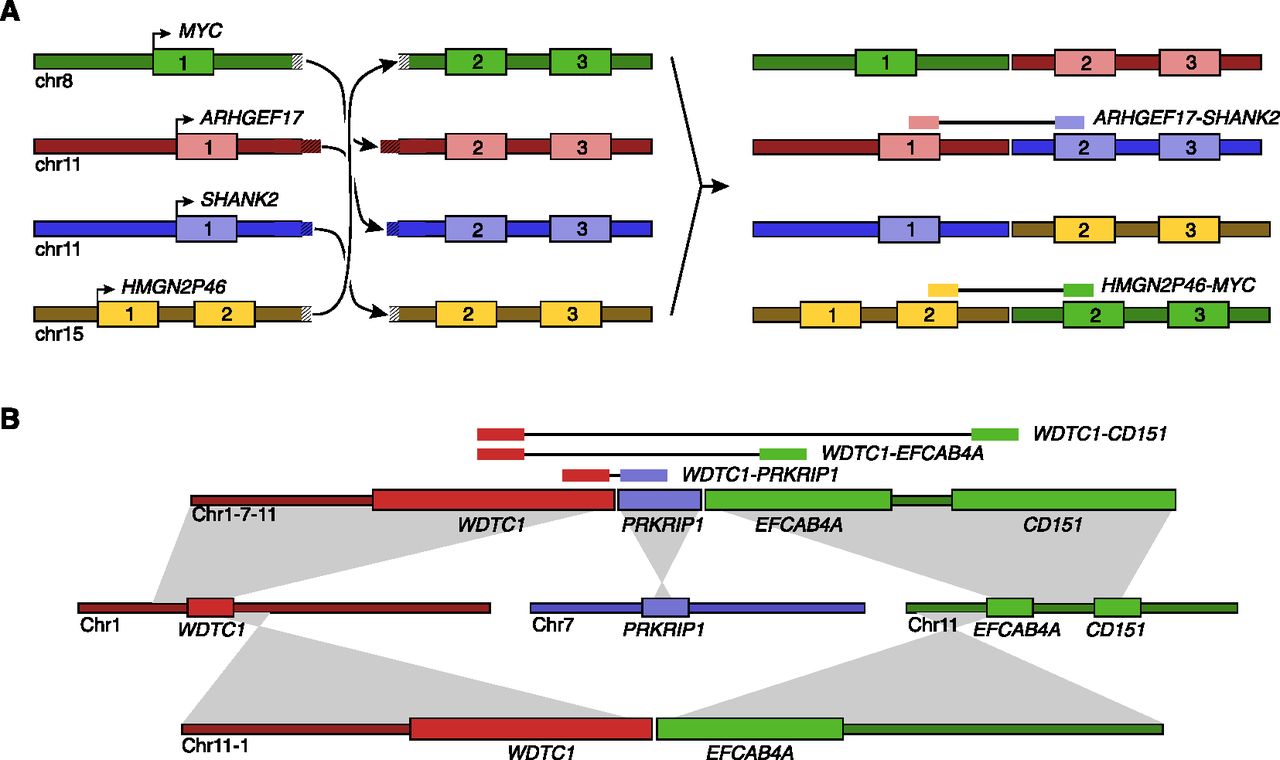
Figure 5.
CGRs discovered in primary tumor sample 963. (A) A single CCBR produces four fusion genes: MYC-ARHGEF17, ARHGEF17-SHANK2, SHANK2-HMGN2P46, and HMGN2P46-MYC. Only the ARHGEF17-SHANK2 and HMGN2P46-MYC fusion genes produce fusion transcripts. (B) Example of a CGR that is both a CCBR and a polyfusion involving three loci. The aberrant 1-7-11 chromosome produces three fusion transcripts: WDTC1-CD151, WDTC1-EFCAB4A, and WDTC1-PRKRIP1.



