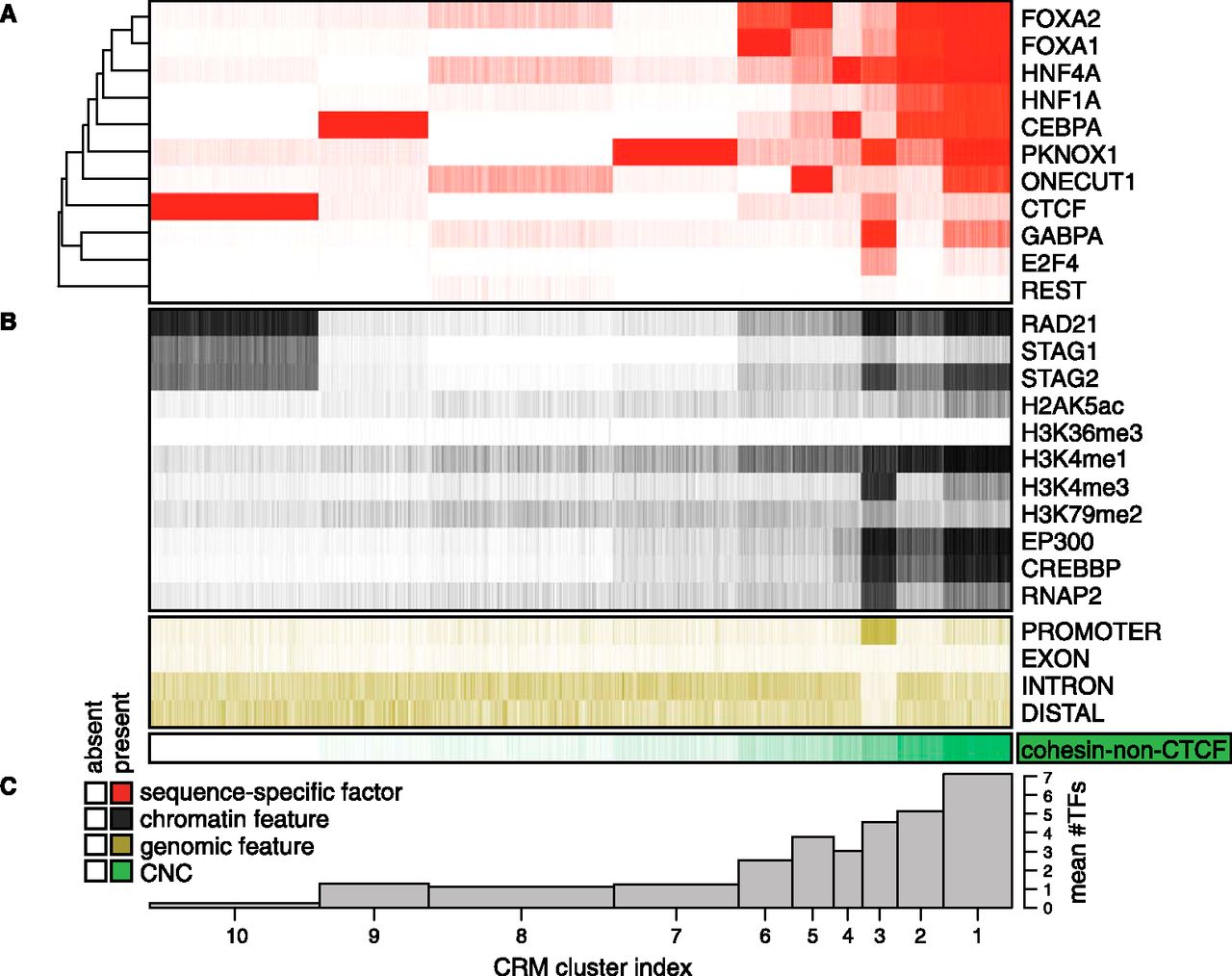
Cohesin-non-CTCF (CNC) binding occurs preferentially at multiply bound CRMs. (A) Results from K-means clustering (K = 10) of the binary presence/absence of ChIP-seq peaks corresponding to the 11 sequence-specific factors within 210,067 CRMs containing at least one of these factors. Factors were clustered based on the similarity in their binary occupancy profiles. The clusters were indexed and sorted by the proportion of CRMs with CNC in each cluster (increasing from left to right). (B) The binary presence/absence of ChIP-seq peaks for various chromatin features (non-sequence-specific factors and histone modifications) visualized according to the K-means results in A. Genomic location with respect to promoters (≤2.5 kb from an annotated TSS), exons, introns, and gene distal regions, is also indicated. The proportion of CRMs with CNC sites in each cluster is indicated at the bottom (increasing from left to right). (C) Barplot indicating the mean number of distinct TFs within each CRM cluster. Bar widths correspond to the number of CRMs within each cluster.