


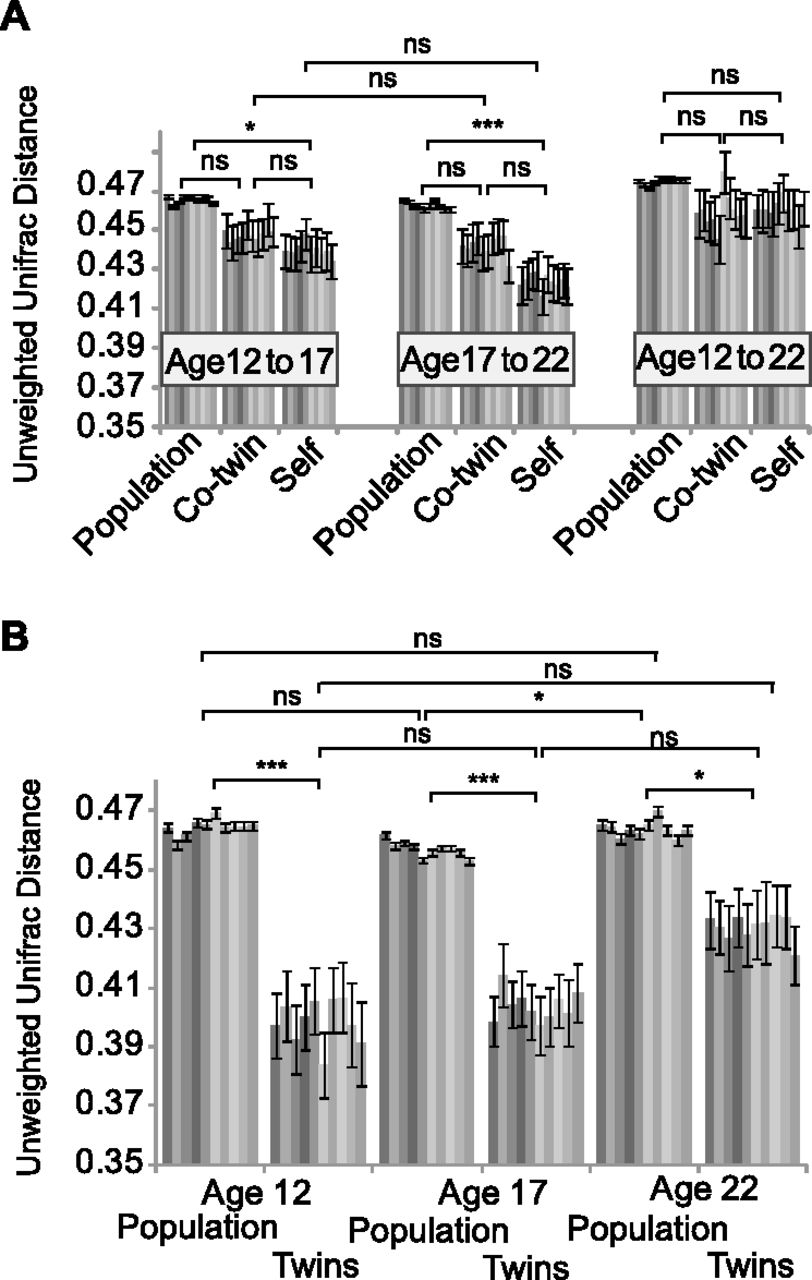
(A) Time progression of individuals, their twins, and the sample population at ages 12, 17, and 22. MZ and DZ pairs were pooled. Age 12–17: Population (n = 6165 pairs), Co-twin (n = 58 pairs), Self (n = 64 pairs); age 17 to 22: Population (n = 5060 pairs), Co-twin (n = 50 pairs), Self (n = 52 pairs); Age 12 to 22: Population (n = 3685 pairs), Co-twin (n = 28 pairs), Self (n = 34 pairs). (B) Similarities based on age of sampling (ages 12, 17, and 22 yr) of twins and the sample population. MZ and DZ pairs were pooled. Pairwise unweighted UniFrac distances of the same person, the person and his/her twin, and the sample population at different ages were calculated (±SEM). The data set was randomly subsampled 10 times at a sequencing depth of 800 sequences/sample. The statistical analysis was a Mann-Whitney U-test. The P-value outcomes are denoted as follows: (ns) nonsignificant, (*) P < 0.05, (**) P < 0.01, (***) P < 0.001. The P-value of each permutation was recorded, and the lowest significance level that has occurred in at least nine out of 10 rarefactions is presented.



