


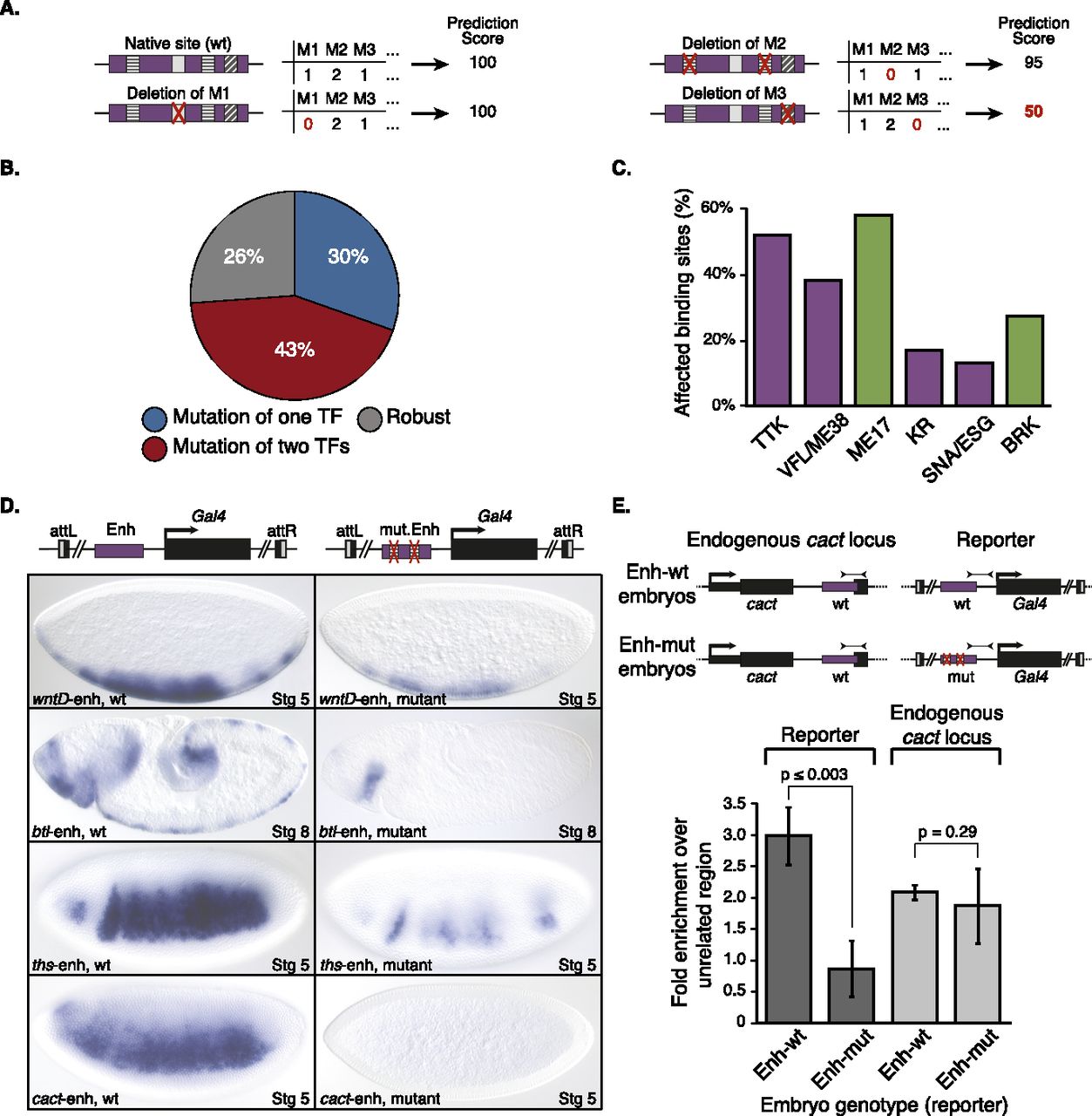
Prediction and validation of early Twist-bound enhancers' cis-regulatory requirements: Vielfaltig's TAGteam motif is a key component of early transcriptional regulation. (A) Schematic overview of the in silico mutations approach. To assess the importance of each particular TF motif (denoted here as M1, M2, M3, etc.), we set the number of its occurrences in the SVM feature table to zero. The differences in the prediction scores after these in silico motif deletions reflect the importance of the motif for the correct prediction of a particular binding site. In the example given, motif M2 (but not M1 or M3) is important for correctly classifying the binding site. (B) Fraction of well-predicted Twist early and late bound sites (prediction score ≥75) that drop substantially (≥20 points) when motifs of one (blue) or two (red) TFs are mutated in silico (the remaining sites are robust; gray). (C) Fraction of sites that are affected by a given motif (from Fig. 4B, blue sector). The most frequent motifs are the TTK-motif and Vielfaltig's TAGteam motif (VFL/ME38) for early (purple) and ME17 for late bound sites (green). Note that the number of sites affected by each motif's ablation is a conservative (i.e., low) estimate due to the overlap of motif instances in the sites' sequences. (D) The activity of early Twist-bound enhancers depends on Vielfaltig's TAGteam (VFL/ME38) motif. The wild-type (wt; left) and TAGteam mutated (right) enhancers of four different genes (btl, wntD, ths, and cact) were placed upstream of a Gal4 reporter gene (see cartoon on top), the expression of which was visualized by in situ hybridization in early Drosophila embryos (bottom). In all cases, the enhancer activity was abolished or strongly reduced when all (between three and five) instances of the TAGteam motif were mutated (all embryos are oriented laterally, dorsal site up, anterior to the left; stages 5 and 8 correspond to 2 and 3 hpf, respectively). Note that we took great care to ensure that comparisons between wild-type and mutant constructs are valid despite the generally semiquantitative nature of enzymatic in situ hybridization: Reporter constructs differed only by the indicated motif-disrupting sequence changes and were inserted into the identical genomic positions (landing site), the identical probe was used in all cases, and hybridizations were performed in parallel. (E) Twist binding depends on Vielfaltig's TAGteam motif. (Top) Schematic cartoons illustrate the genotype of the transgenic embryos, which carry a Gal4 reporter construct for the Twist-binding site in the cact locus (purple) with either the wild-type sequence (Enh-wt) or a sequence in which all four TAGteam motifs are mutated (Enh-mut). The inward pointing arrowheads indicate the primer pairs used to distinguish the endogenous cact locus (left) and the reporter (right) during qPCR (note that they are offset from the ChIP-chip peak summit to discriminate between the different sequence constructs). (Bottom) Twist ChIP-qPCR results from stage 5–7 embryos (2–4 hpf) that carry either the wild-type (wt) or the TAGteam mutant (mut) reporter. Shown is Twist ChIP enrichment (percent recovery compared with an unrelated genomic region) at the reporter (dark bars) and the endogenous cact locus (light bars). Error bars indicate standard deviations of three biological replicates from independent embryo collections (replicates are shown individually in Supplemental Fig. S4); P-values from t-tests are shown.



