


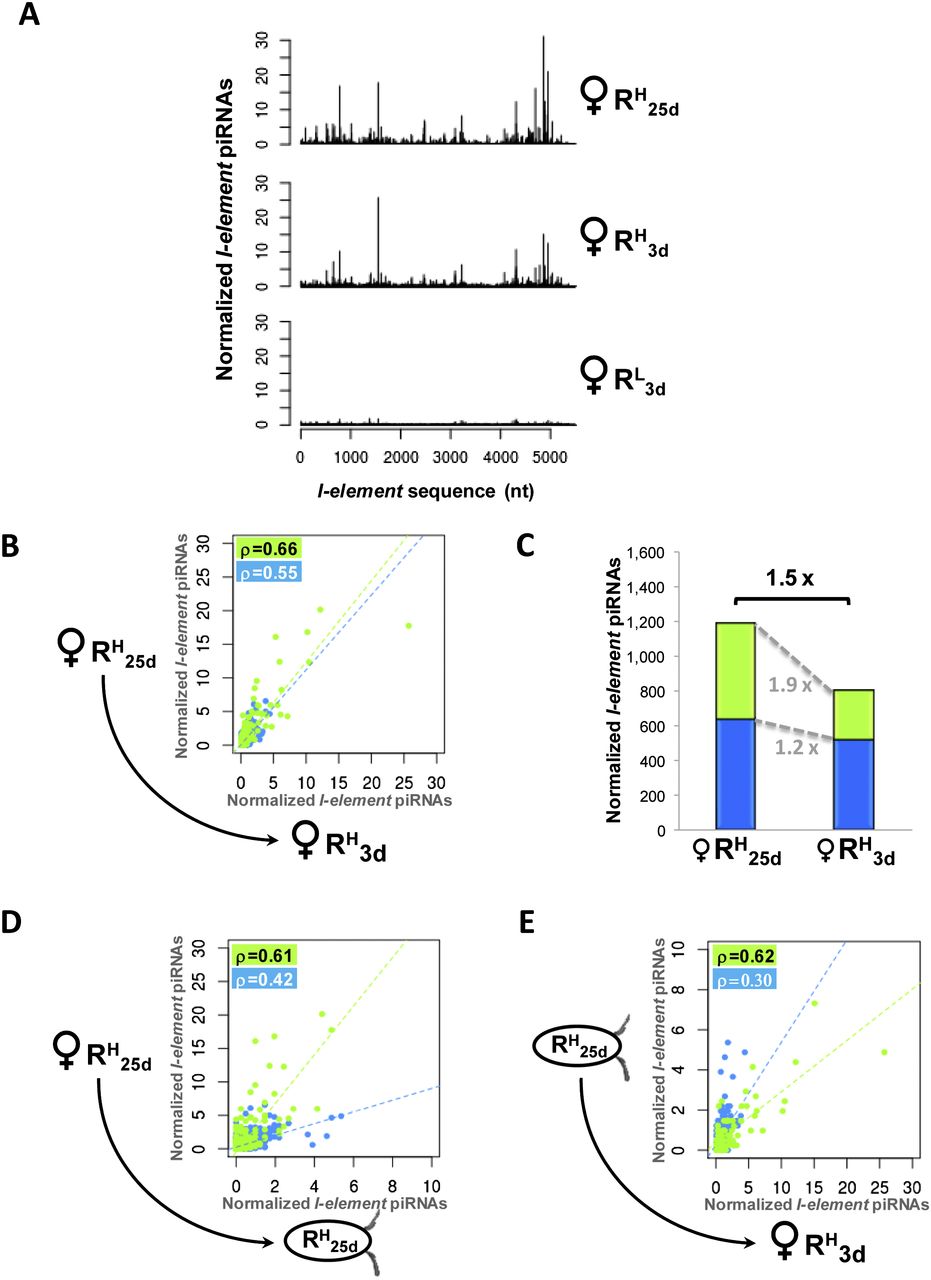
Maternally deposited piRNAs are the epigenetic vectors of the memory of the aging effect. (A) The density profiles of ovarian I-element piRNAs (up to four mismatches) were strikingly similar between the aged mothers (RH25d) and the young daughters (RH3d), but different from those of RL3d flies. (B,D,E) Scatter plots displaying the correlations between normalized read counts for I-element piRNAs. Each point displays the normalized counts of reads collapsed to their 5′ end for all I-element positions. (Green) Points corresponding to ping-pong positions in the RH3d ovary library. (Blue) Positions without ping-pong partner, in the RH3d library. (B) Correlation for I-element ovarian piRNAs sequenced in the aged mothers and their young daughters (Spearman's rank correlation test: for ping-pong positions: ρ = 0.66; P < 10−16, n = 289; for others: ρ = 0.55; P < 10−16, n = 1017). (D) Correlation for I-element piRNAs sequenced in the aged mothers and their eggs (Spearman's rank correlation test: for ping-pong positions: ρ = 0.61; P < 10−16, n = 151; for others: ρ = 0.42; P < 10−16, n = 528). (E) Correlation between I-element piRNAs sequenced in the eggs laid by aged mothers and in the ovaries of the corresponding young daughters (Spearman's rank correlation test: for ping-pong positions: ρ = 0.62; < 10−16, n = 164; for others: ρ = 0.30; P < 10−16, n = 620). (C) Normalized counts of I-element piRNAs in RH25d and RH3d ovaries when they are split into piRNAs with sequenced ping-pong partners (green) and the others (blue). Indicated values correspond to RH25d/RH3d piRNA level fold change.


