


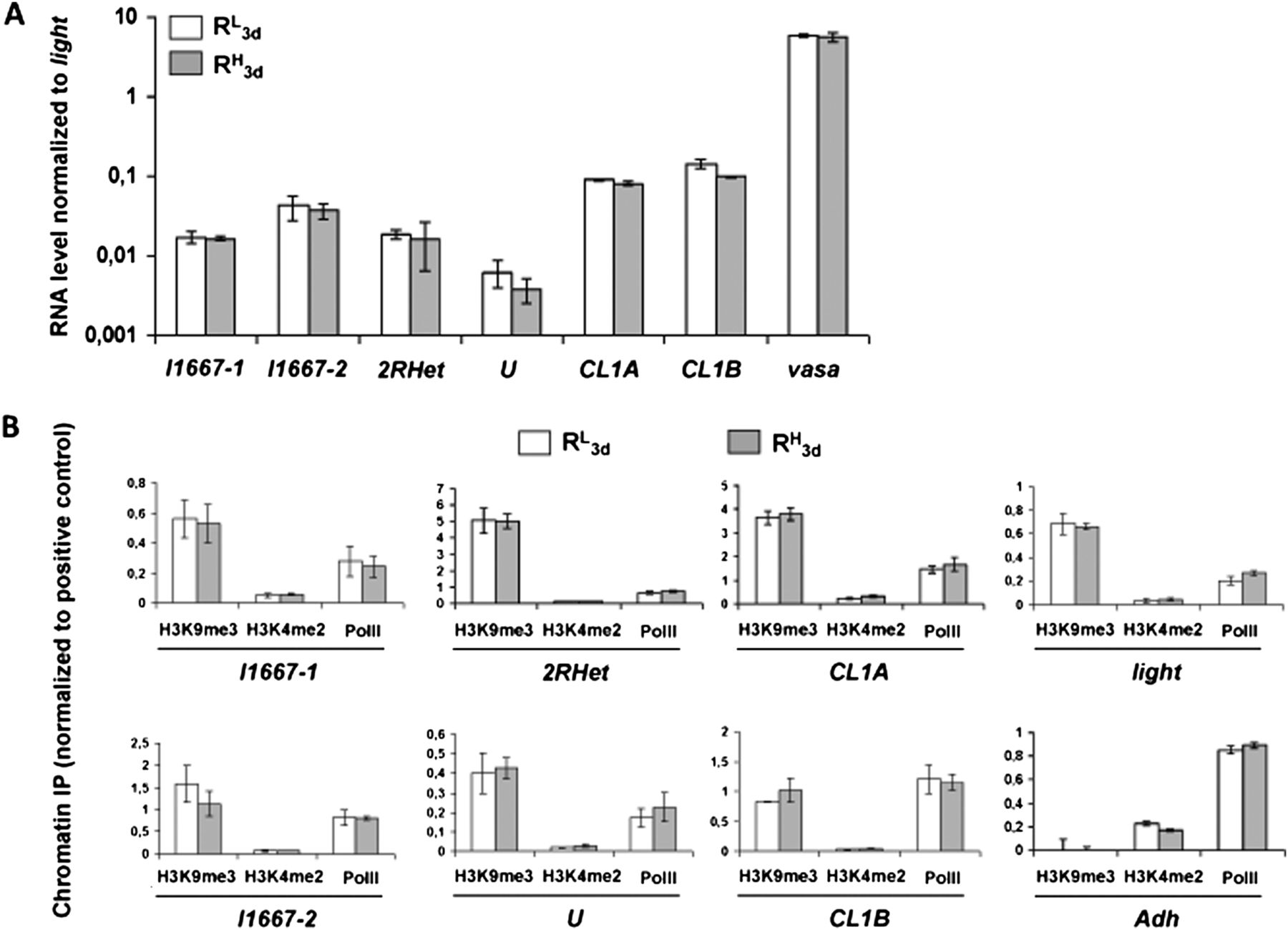
Transcription and chromatin marks of the I-element piRNA producers are not affected by ancestor aging. (A) Quantitative real-time PCR on randomly reverse-transcribed total RNA from RL3d (white bars) and RH3d (gray bars) ovaries. The relative levels of transcripts were measured for four genomic loci containing defective I-elements, as well as two non-I-element–containing 42AB genomic loci and vasa. Values were normalized to the mRNA level of light (bars, mean ± SD; two-tailed Student t-test P > 0.05, n = 3). (B) Chromatin immunoprecipitation assay using chromatin extracts from RL3d (white bars) and RH3d (gray bars) ovaries. Eight genomic loci have been studied. H3K9me3 immunoprecipitates were normalized to 1360-element positive control; H3K4me2 and Pol II immunoprecipitates, to rp49 positive control (bars, mean ± SD; two-tailed Student's t-test P > 0.05, n = 3). light and Adh were used as examples of actively transcribed genes in heterochromatic and euchromatic regions, respectively.


