


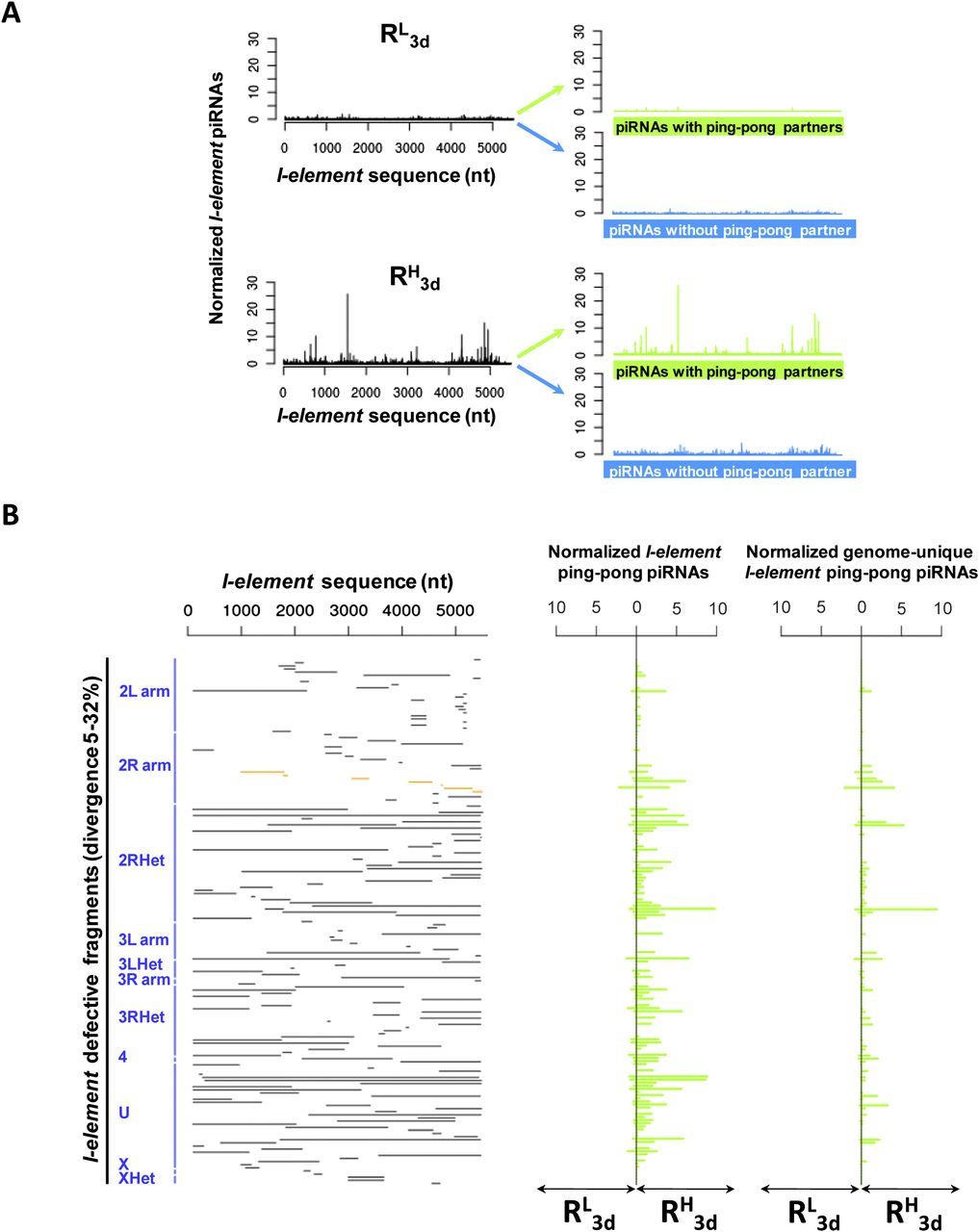
Evidence for ping-pong amplification between defective I-element fragments. (A) Density profile of piRNAs matching the I-element (up to four mismatches) when they are split into piRNAs with ping-pong partners (green) and other piRNAs (blue). (B) Most of the I-element defective fragments contributed to the ping-pong–mediated amplification of I-element piRNAs in the offspring of aged ancestors. Each horizontal bar indicates one of the I-element–defective fragments annotated in the Release 5 genome sequence that were aligned to the functional I-element sequence and sorted by chromosomal positions (the I-element fragments located in the 42AB cluster [orange]). Green bar diagrams indicate the abundance of their corresponding piRNAs with ping-pong partners in the two libraries (RH3d and RL3d ovaries). (Left) Total piRNA levels, including read counts of piRNAs mapping to several defective I-elements weighted by their mapping number; (right) levels of piRNAs that map uniquely to each defective I-element.


