


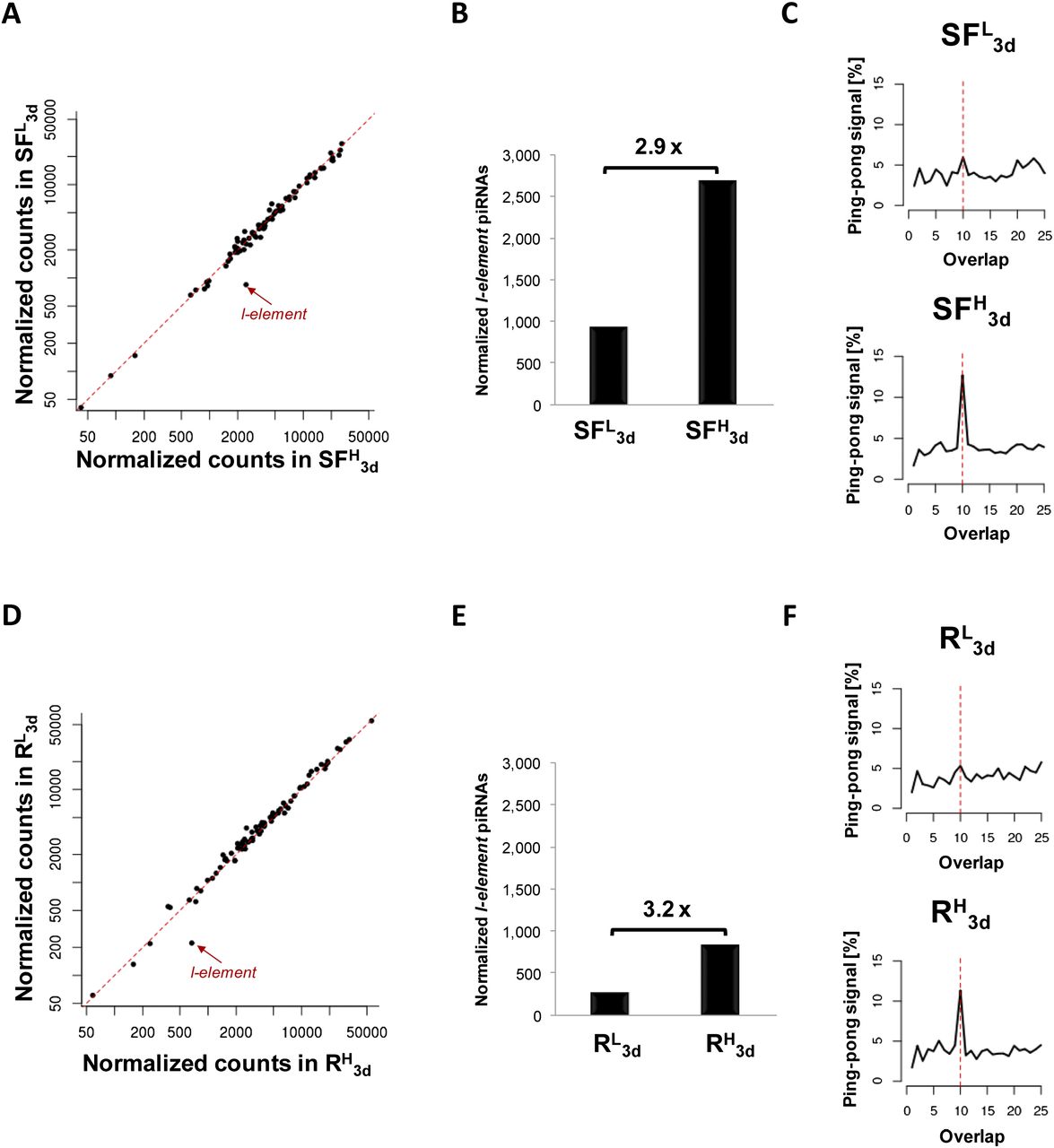
Figure 2.
Aging treatment boosts the production of I-element piRNAs in the next generations. (A,D) Pairwise comparison of the TE piRNA levels in ovaries from 3-d-old isogenic flies (SFL3d, SFH3d and RL3d, RH3d) that have young or aged ancestors, respectively. Scatter plots display correlation between normalized piRNA abundances for each of the 85 most highly targeted Drosophila TEs (up to four mismatches allowed between reads and RepBase sequence). (B,E) Normalized counts of ovarian I-element piRNAs shows that they are increased in the offspring of females with aged ancestors. (C,F) A ping-pong signature for the I-element could only be detected in the progeny of aged ancestors.



