


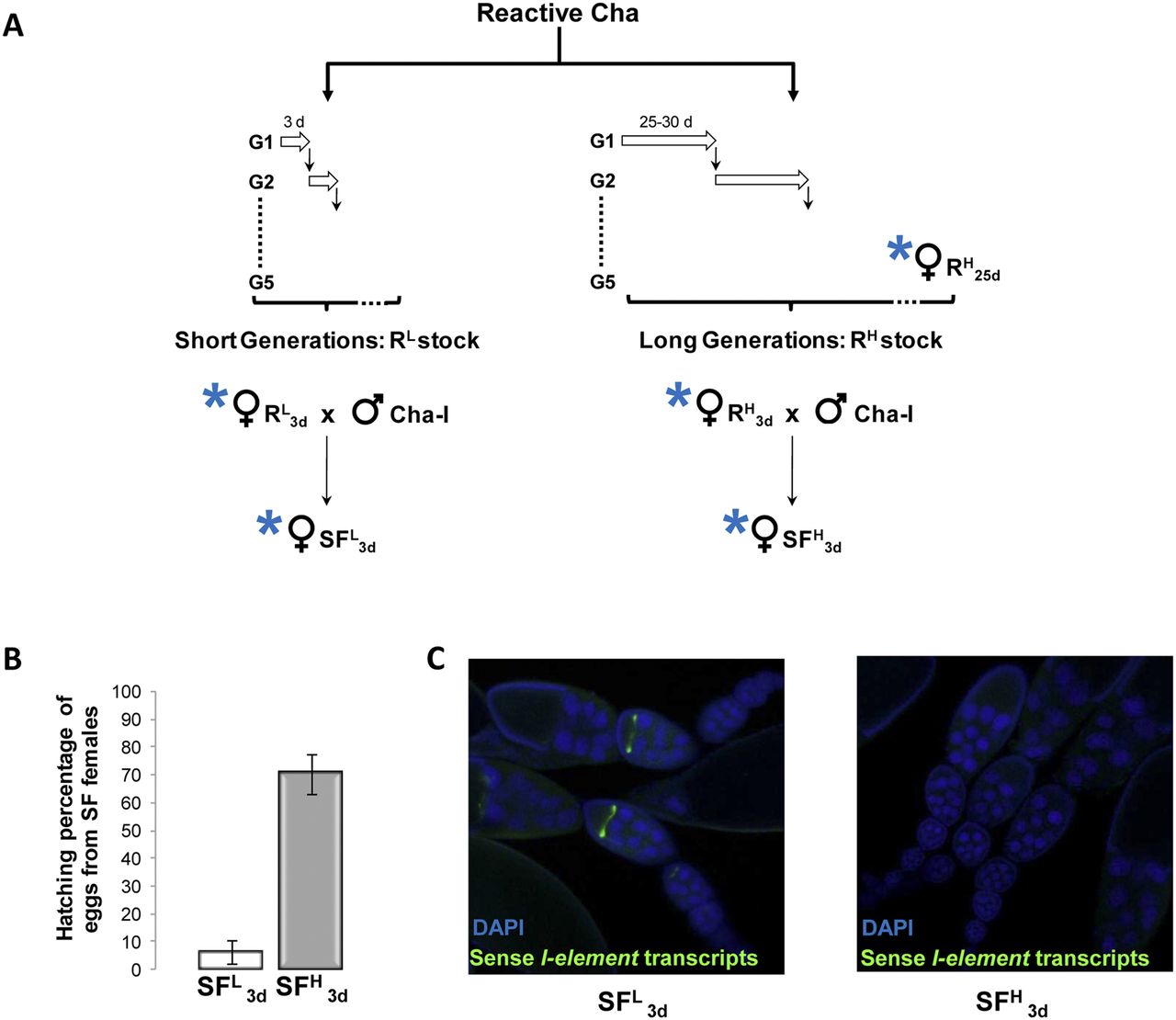
The rescue of SF sterility induced by aging treatment of the maternal ancestors correlates with I-element repression. (A) Schematic representation of the biological model. The reactive (R) Cha strain was divided into two stocks and bred during at least five successive short or long generations to produce isogenic RL and RH stocks, respectively. Short and long open arrows correspond to the age of the egg-laying females (3-d-old and 25- to 30-d-old, respectively) used to produce the subsequent generation. Three-day-old females from both stocks were crossed with Cha-I inducer males to generate SFL and SFH females. The blue asterisks highlight flies the ovaries and eggs of which were used to perform small RNA sequencing. (3d) 3-d-old females; (25-30d) 25- to 30-d-old females. (B) Histogram showing the hatching percentage of eggs from SFL3d (white) and SFH3d (gray) females (bars, mean ± SD; Wilcoxon signed-rank test P = 10−12, n = 33 vials). (C) RNA FISH on whole-mount preparations of ovaries from SFL3d (left panel) and SFH3d flies (right panel) using a FITC-conjugated antibody against a biotin-labeled antisense riboprobe specific for I-element sense transcripts. I-element sense transcripts were detected (green) only in oocytes of SFL ovaries. Ovaries were counterstained with DAPI (blue).



