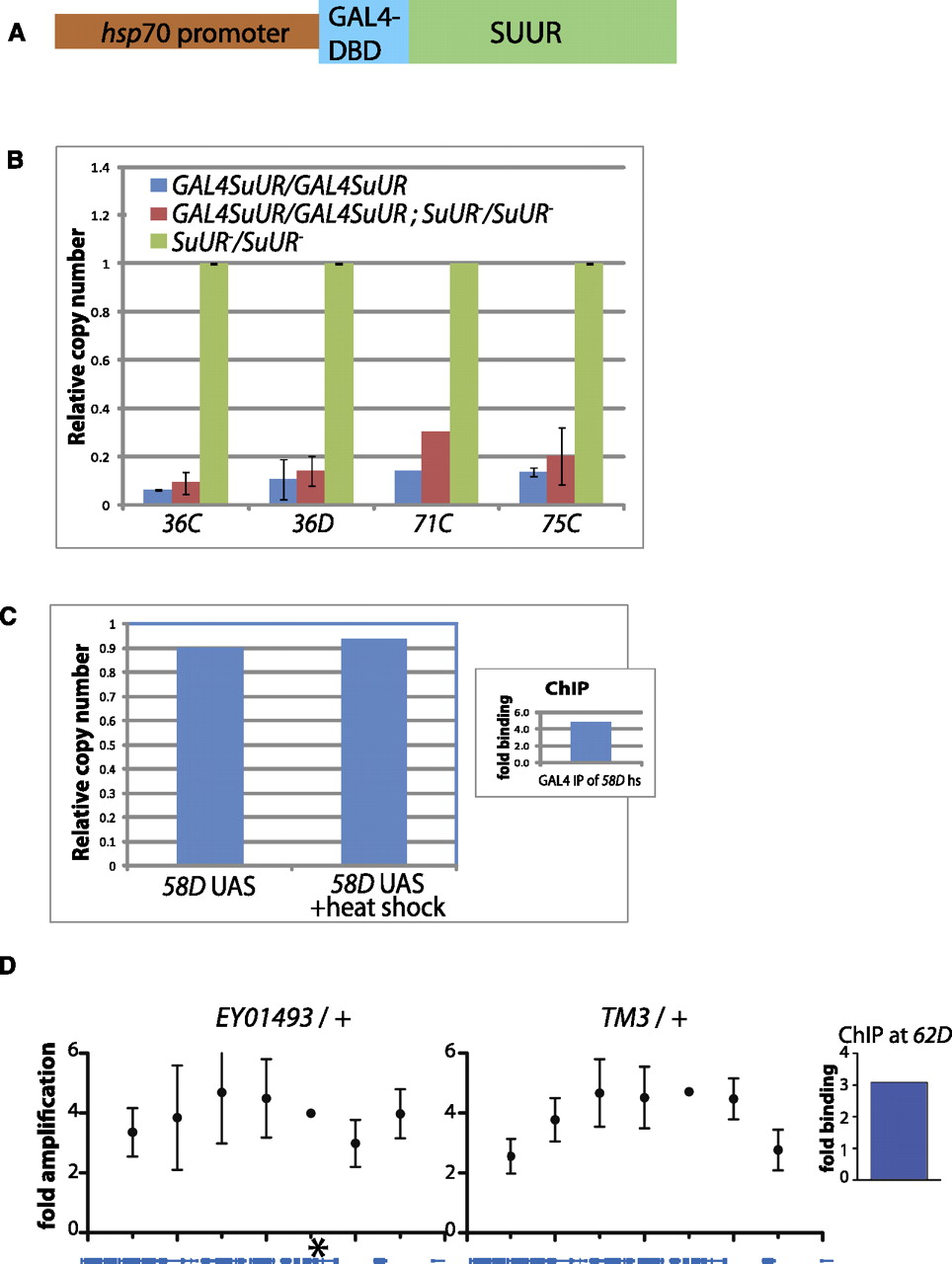
Tethering experiments indicate that tethering of a single SUUR is not sufficient to induce under-replication in salivary glands or to impede fork movement in a follicle cell amplicon. (A) Insertion constructed for tethering experiments, SUUR fused in frame to the DNA binding domain (DBD) of GAL4, with an hsp70 promoter. (B) Complementation assays showing that GAL4DBD-SUUR is capable of functioning as wild-type SUUR protein, restoring under-replication in SuUR mutant larvae. Copy number is relative to a control fully replicated locus. (C) Tethering of GAL4DBD-SUUR at a fully replicated locus is not sufficient to induce under-replication. (Inset) GAL4DBD-SUUR was bound to the UAS as analyzed by ChIP analysis relative to a negative control locus (pol α, where GAL4 is not bound). (D) Tethering of GAL4DBD-SUUR to the DAFC-62D amplicon in follicle cells does not affect amplification levels. The left panel shows the DNA copy number across the amplicon with GAL4DBD-SUUR tethered at the position designated by the asterisk. The right panel shows the sibling controls without the UAS binding site subjected to the same heat shock induction. The inset panel shows that GAL4DBD-SUUR was bound to the UAS, as determined by ChIP analysis.