


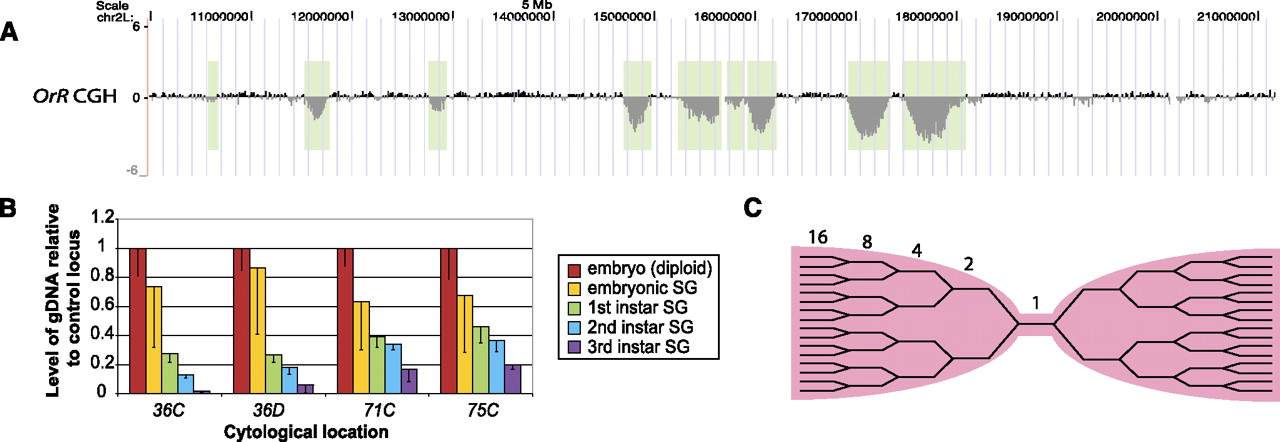
Euchromatic regions are repressed for replication early in development. (A) aCGH of the proximal euchromatic half of chromosome 2L of Drosophila Oregon-R (OrR) third-instar salivary glands indicates the presence of euchromatic under-replicated regions. The genome profile shows the log2 ratio of copy number in the third-instar salivary gland genome relative to that of diploid embryonic DNA. Under-replicated loci are indicated by vertical light green bars. OrR flies are the wild-type strain used throughout this study. For this and other figures, UCSC Genome Browser (build dm3) was used (http://genome.ucsc.edu) (Rhead et al. 2010; Fujita et al. 2011). (B) Under-replication begins with the first endocycle in the embryonic salivary gland. Levels of DNA at four under-replicated loci relative to a fully replicated control locus were measured by qPCR in embryonic and first-, second-, and third-instar salivary glands. The diploid whole-embryo sample shows a 1:1 ratio between any two DNA loci. Error bars, SD of three biological replicates. By a one-sample t-test, the embryonic salivary gland sample is significantly different from the diploid embryo sample, P = 0.012. (C) Model of replication fork structure at under-replicated region.



