


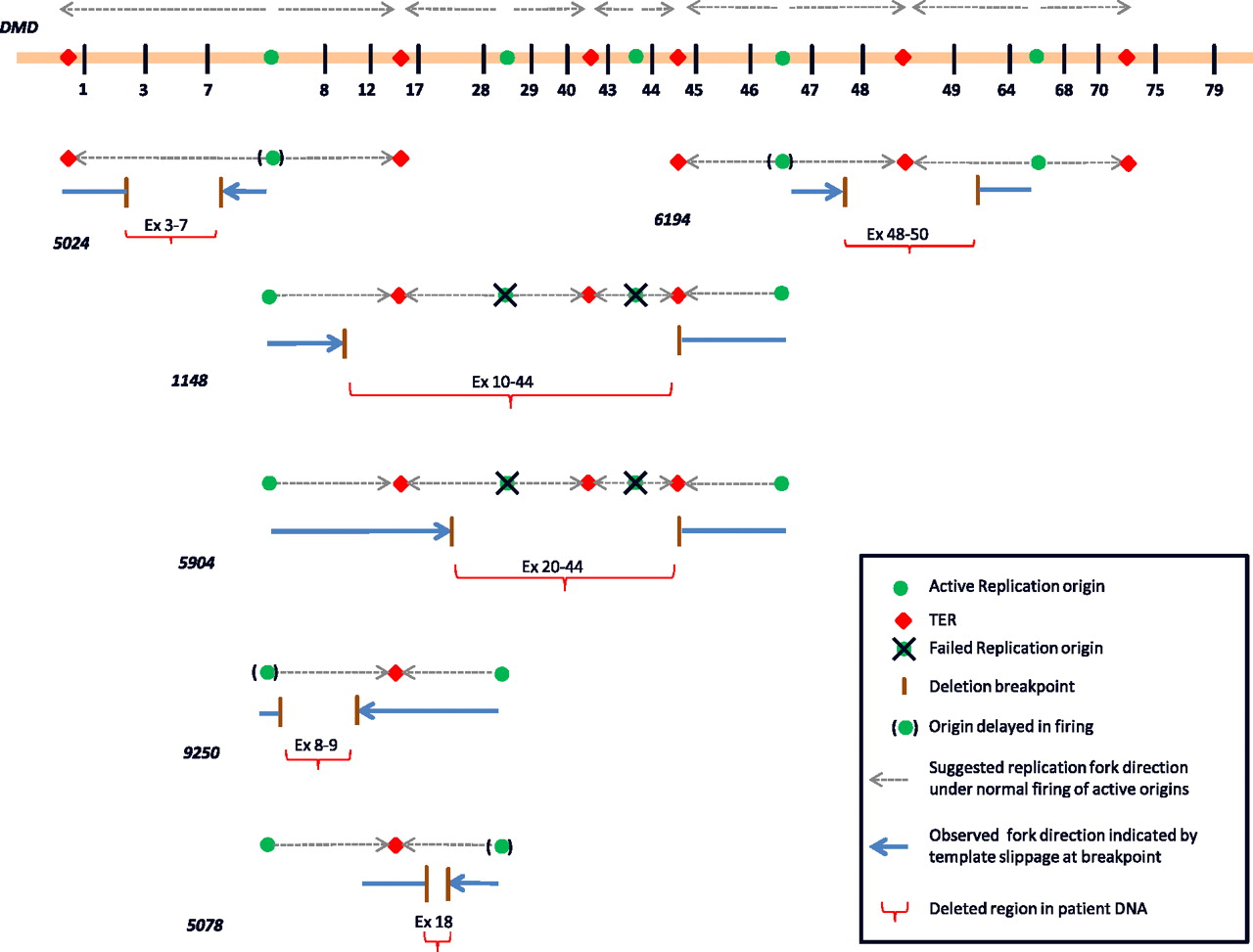
Illustration of the proposed deletion mechanism as explained by failure of replication origins in different patient cases. As shown for each of the six patient cases (5024, 6194, 1148, 5904, 9250, and 5708), failure/delay in origin firing may result in incomplete replication, causing DNA deletion. For example, in patient 5904, failure of origins in introns 28 and 43 may have led to deletions of exons 20–44. The horizontal bar at the top represents the DMD gene with the five mapped replication origins (green circles) and the six termination regions (red rhomboids), along with adjacent numbered exons (vertical black bars). The numbers in bold italics represent the patient sample. For each patient sample illustrated above, we show the template with origins and terminal regions adjacent to the deletion (gray arrowheads showing the direction of replication forks). (Brown horizontal bars) Deletion breakpoints (or replication cease points); (blue bars) patient DNA (or newly replicated DNA); (blue arrowheads) the replication fork direction at breakpoint. The directions of the replication forks are predicted based on the presence of re-replicated sequences at either breakpoint junction. For example, in sample 5024, the template slippage was found at the breakpoint in intron 7, whereas in sample 6194, the template slippage and sequence repetition was found to be at the breakpoint in intron 47. (Red horizontal braces) Corresponding deletion, with the deleted exons mentioned. The crossed-out origins represent replication origins that probably failed to fire during S phase.



