


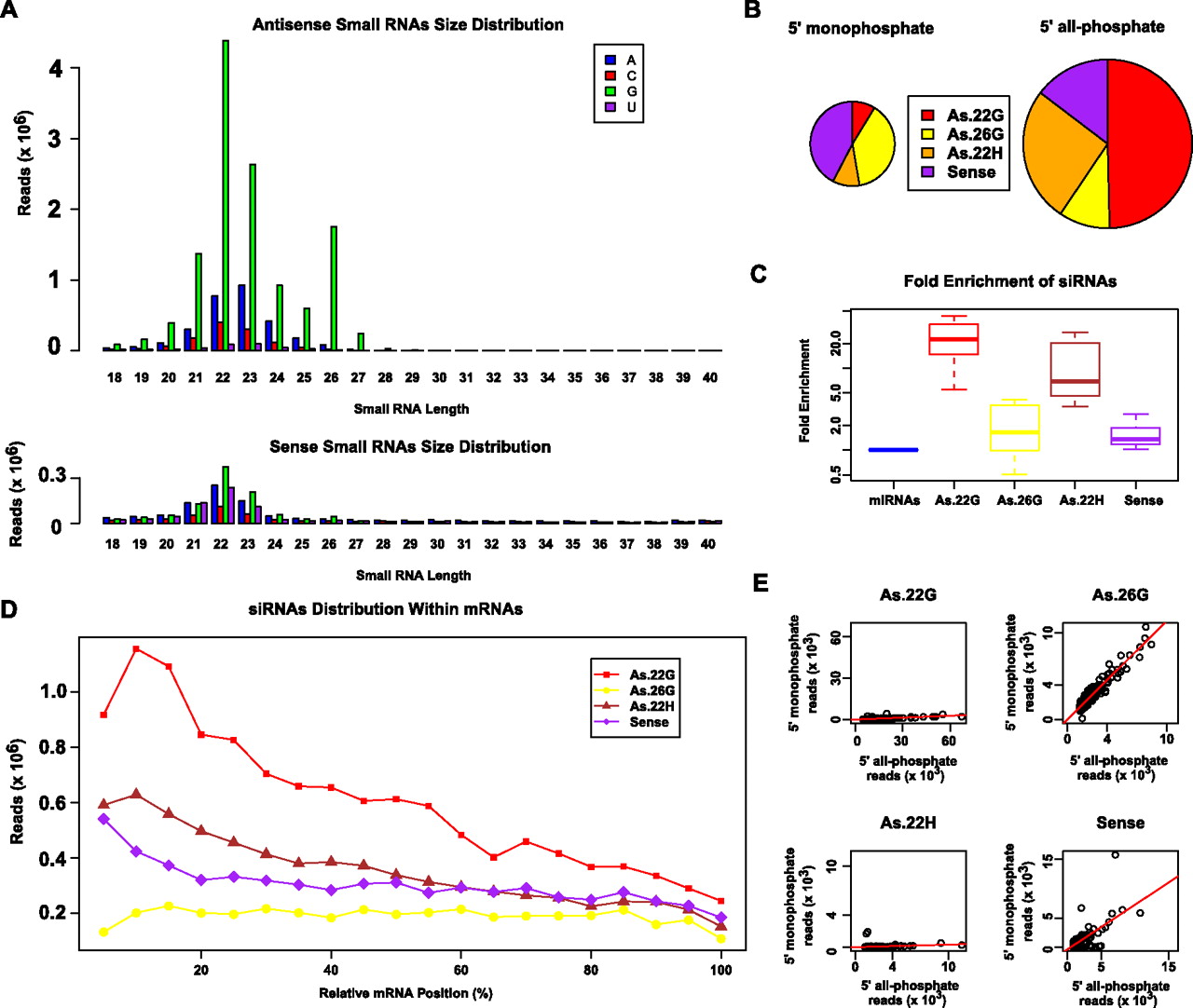
Ascaris endo-siRNAs to mRNAs. (A) Size distribution of small RNA raw reads corresponding to mRNAs from 17 5′ all-phosphate libraries. (Upper panel) Antisense small RNAs; (lower panel) sense small RNAs. (B) Comparison, classification, and levels of normalized small RNAs corresponding to mRNAs. Area of the circles is proportional to the amount of different types of small RNAs (see text) present in the 5′-mono- and 5′-all-phosphate libraries. (C) Twenty-two-nucleotide small RNAs are polyphosphate RNAs, whereas 26G-RNAs are monophosphate RNAs. miRNAs were used to normalize the reads between 5′ monophosphate and 5′ all-phosphate libraries. In these and all subsequent box-and-whisker plots, the top and bottom ends of each box represent the 75th and 25th percentile, respectively; the middle line represents the median value; the extended lines illustrate the range (highest and lowest value); and dots represent values beyond the extremes of the whisker. (D) siRNA distribution on mRNA transcripts. Different types of small RNA reads from 5′ all-phosphate libraries are plotted for 8279 full-length cDNAs. Each mRNA is equally divided into 20 bins, and small RNAs mapped to each bin were counted. Plotted is the sum of the counts (y-axis) against the relative position (x-axis) on the cDNA from 5′ to 3′, with the 5′ end of the mRNA designated as 1 and the site of polyadenylation at the 3′ end designated as 100. (E) Twenty-two-nucleotide monophosphate RNAs are likely derived from 22-nt polyphosphate RNAs. Plots illustrate a comparison of small RNA reads between 5′ all-phosphate libraries (x-axis) and 5′ monophosphate libraries (y-axis). The data sets are the top 200 siRNAs in read frequency.



