


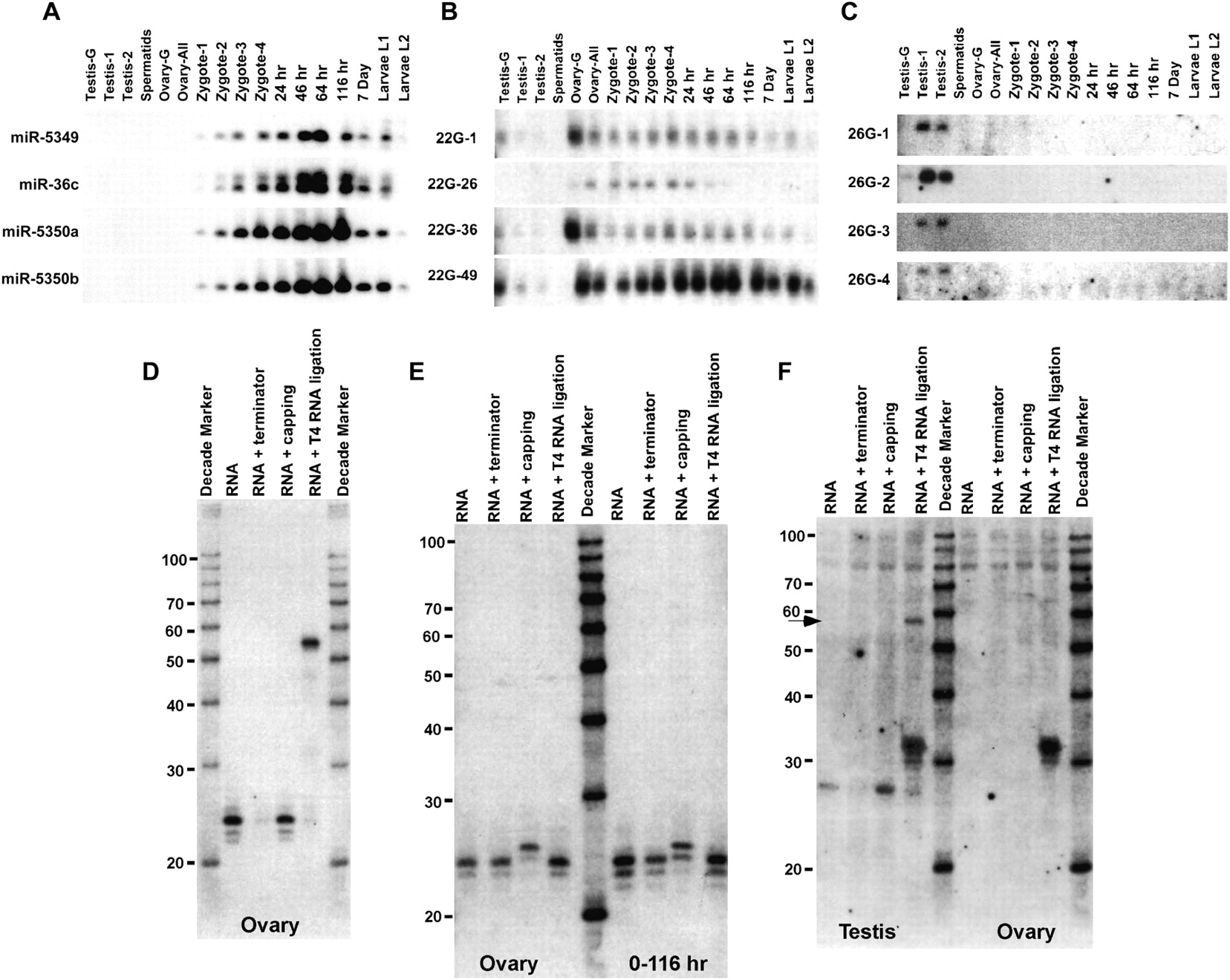
Ascaris small RNAs expression and their 5′ phosphate termini. (A) Northern blots illustrating intrauterine zygotic expression of miRNAs (for whole blots, see Supplemental Fig. S6A). (B) Northern blots illustrating dynamic expression of 22G-RNAs. (C) Northern blots illustrating expression of testis-specific 26G-RNAs. (D) Ascaris miRNAs have a 5′ monophosphate. Northern blot of Ascaris LMW RNA untreated or treated with terminator, GTP and guanylyltransferase (capping), or ligation of an RNA oligonucleotide (T4 RNA ligation) and probed with asu-miR-5347 probe. Note that the miRNA is degraded by terminator, is uncapped, and can be ligated to an RNA oligonucleotide, indicating the 5′ end is a monophosphate. (E) Ascaris 22G-RNAs have 5′ polyphosphates. Northern blot as in D probed with a 22G-RNA probe. Note that the 22G-RNA can be capped but is not susceptible to terminator or T4 RNA ligation, suggesting the 5′ end of the RNA is a di- or triphosphate. (F) Ascaris 26G-RNAs have a 5′ monophosphate. Northern blot as in D probed with a 26G-RNA probe. Note that the 26G-RNA is testis specific and is degraded by terminator, is uncapped, and can be ligated to an RNA oligonucleotide, indicating the 5′ end is a monophosphate. The band at ∼32 nt in the RNA+T4 RNA ligation is an artifact in the ovary.



