


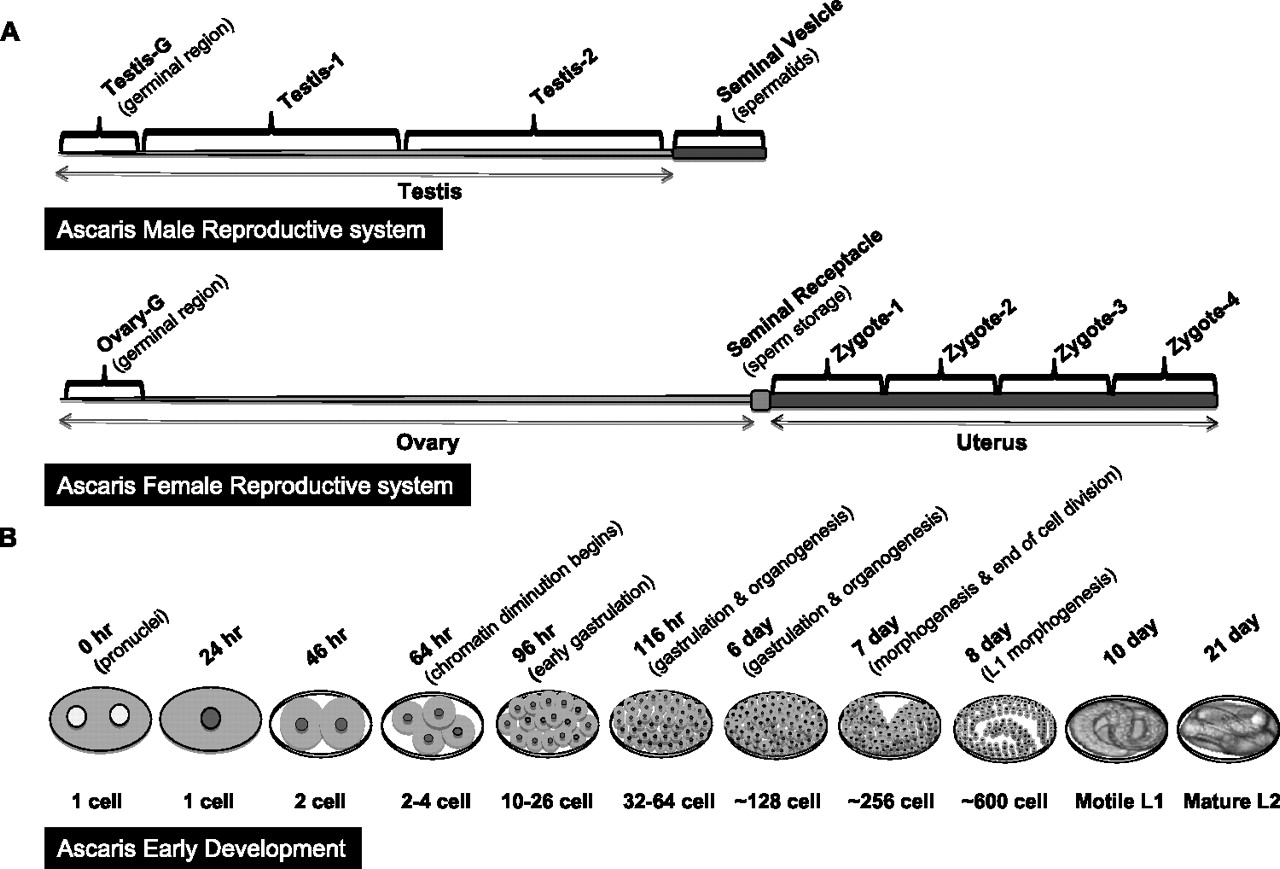
Ascaris reproductive systems and early development. (A) Ascaris male and female reproductive systems. The male seminal vesicle contains spermatids that are activated on fertilization of a female. Sperm are stored in the female seminal receptacle. As mature oocytes move through the seminal receptacle, they are fertilized, and for each fertilized egg, an impermeable layer and chitinous shell is immediately formed around the egg in region one of the uterus (zygote-1). The zygote undergoes maturation as it passes through the uterus (within 12–24 h). Note that the figure is not drawn to scale. Extended male and female reproductive systems are ∼140 cm and ∼240 cm in length, respectively. (B) Early Ascaris embryo development. Eggs derived from the region designated as zygote-4 are equivalent to 0-h embryos. Incubation of 0-h embryos at 30°C in high humidity leads to relatively synchronous development (∼85%) as illustrated. The maternal to zygotic transition is thought to occur between 46 and 96 h of development (four to 16 cells). Ascaris larvae L1 and L2 remain within the chitinous shell. The 0-h embryo is ∼100 × 45 μm and does not change in size during development as illustrated. All regions/stages in A and B were analyzed in the study.



