


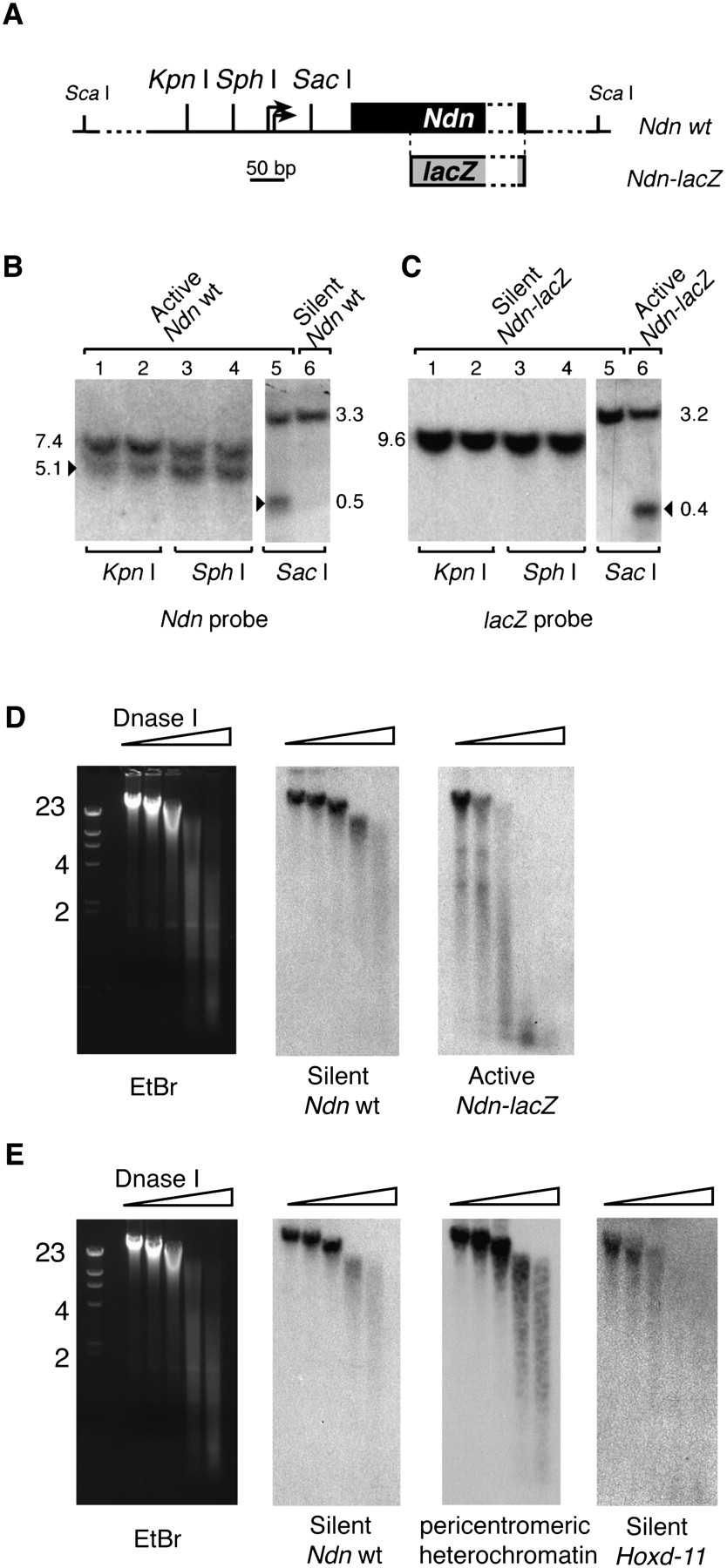
Transcriptional silencing at Ndn is associated with a chromatin structure that occludes DNA access to nucleases. (A) Ndn promoter organization with the position of restriction sites. The two transcription initiation sites are indicated with arrows. The position of lacZ in the fusion allele is shown. (B) Nuclei were prepared from E17 fetal brains and digested with KpnI, SphI, or SacI. DNA was prepared, cut with a second restriction enzyme (e.g., ScaI), and run on an agarose gel. DNA was then transferred to a nylon membrane, which was hybridized with a Ndn coding sequence [α-32P]-labeled probe. Ndn coding sequence is deleted in the Ndn-lacZ allele, and therefore this probe reveals only the wild-type Ndn allele. In all lanes, a single band indicates absence of digestion, whereas the presence of a second smaller DNA fragment (arrowhead) indicates digestion by the restriction enzyme at the Ndn promoter. In lanes 1 to 5, nuclei were prepared from fetal brains carrying a paternally contributed (active) wild-type allele and a maternally contributed (silenced) Ndn-lacZ fusion allele. In lane 6, nuclei were prepared from fetal brains carrying a paternally contributed Ndn-lacZ allele and a maternally contributed wild-type Ndn allele. (C) The membrane was then stripped and rehybridized with the lacZ probe. (D) Nuclei were prepared from E17 fetal brains carrying a maternally contributed (silenced) wild-type Ndn allele and a paternally contributed (active) Ndn-lacZ fusion allele, and digested with increasing amounts of DNase I. DNA was prepared, run on an agarose gel, and transferred to a nylon membrane that was hybridized with a first [α-32P]-labeled probe. After autoradiography, the membrane was stripped and rehybridized with a second probe. Ethidium bromide (EtBr) staining of DNA before transfer is shown on the left. The membrane was hybridized successively with Ndn exon probe, revealing the silenced wild-type Ndn allele, and lacZ probe, which reveals the active paternally contributed Ndn-lacZ allele. (E) The membrane was first hybridized with a probe against the silenced wild-type Ndn allele, then with a major satellite repeat probe, which reveals pericentromeric heterochromatin DNA, or a Hoxd11 probe.



