


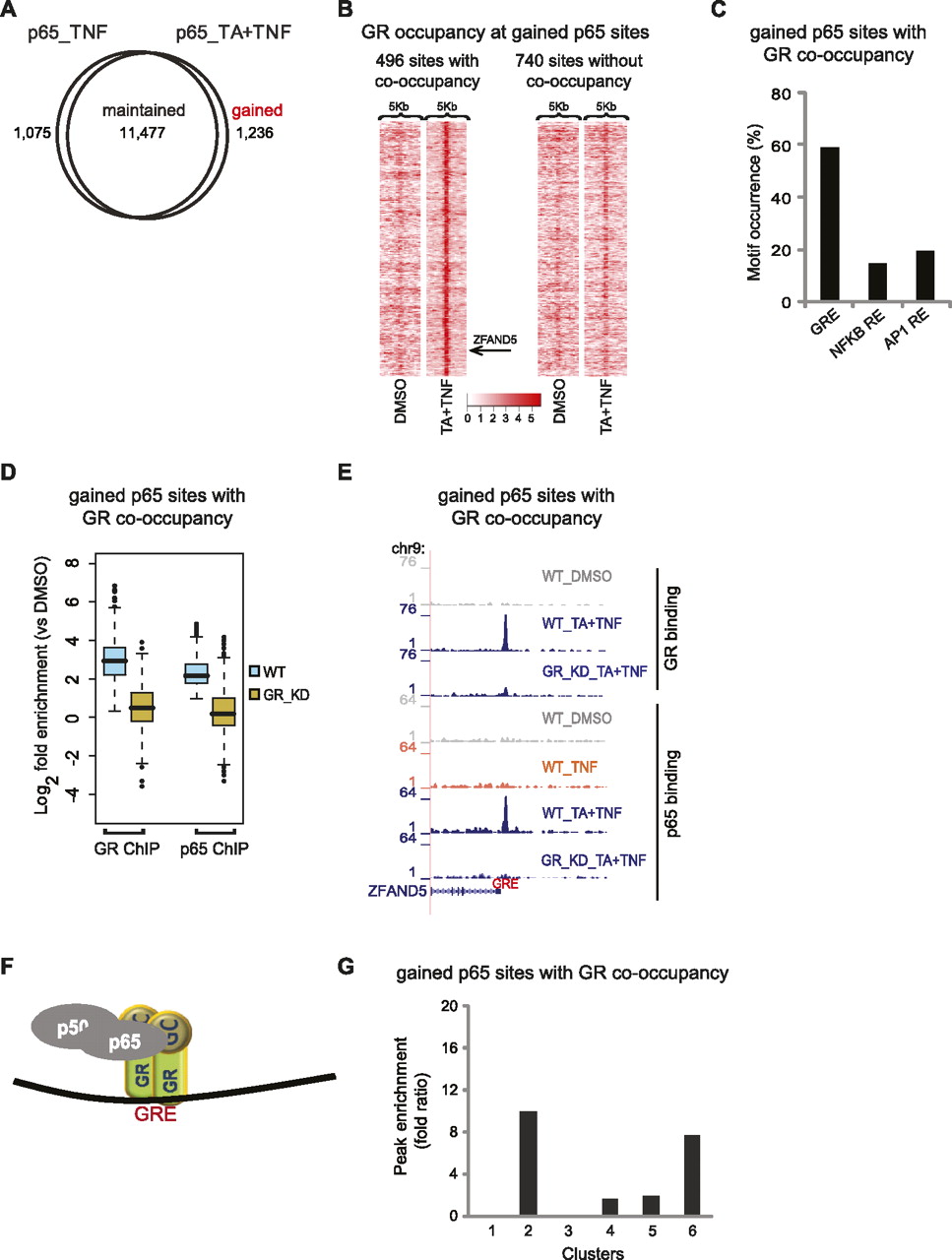
Gained p65-binding sites and their correlation to gene expression profile. (A) Profile of p65 binding sites. Venn diagram of the overlap of p65 sites detected upon treatment with TNF or TA + TNF. (B) Tag density maps depicting the pattern of GR occupancy around (peak mode ±2.5 kb) gained p65 sites. Color density indicates the level of GR occupancy (square root of tag density; see scale below) in a 250-bp window. The position of the example presented in E (ZFAND5) is indicated. (C) Motif occurrence within gained p65 sites co-occupied by GR. The bar graph shows the percentage of sites containing the indicated motifs. (D) Boxplots of GR and p65 tag counts distributed under peak locations (log2 scale) of gained p65 sites co-occupied by GR, upon TA + TNF treatment, in WT cells, and the respective tag distributions under the same locations in GR_KD cells. (E) p65 and GR ChIP-seq data illustrate binding of p65 and GR at gained p65 sites co-occupied by GR, detected upon the indicated treatments, in WT and p65_KD cells. Data were viewed in the UCSC Genome Browser. The maximum number of overlapping tags, representing peak height, is indicated on the y-axis. (F) Model of GR and p65 interaction at gained p65 sites co-occupied by GR. (G) Enrichment of gained p65 sites co-occupied by GR that are assigned to the genes of each cluster. Peak enrichment fold ratio is as described in Figure 5G.



