


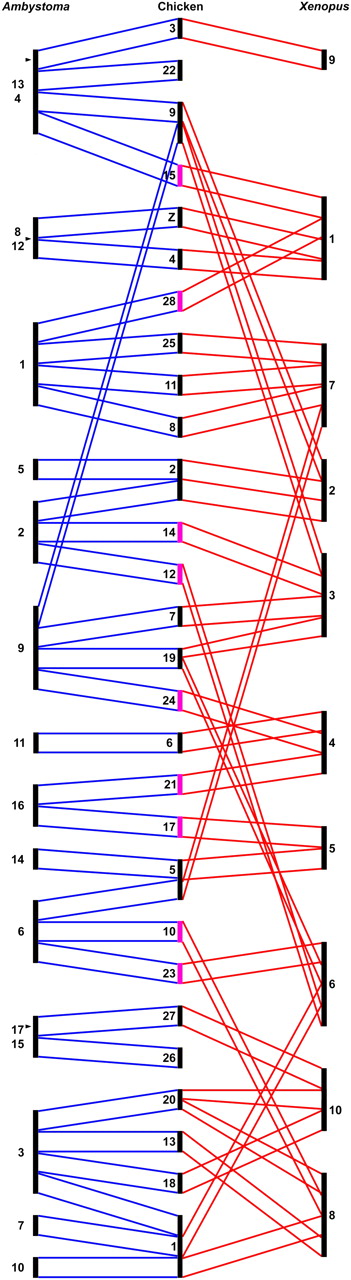
Conserved syntenies among Ambystoma mexicanum/A. tigrinum, chicken, and X. tropicalis genomes. Proposed ancestral chromosomal blocks are delimited by blue lines drawn between Ambystoma and chicken chromosomes. Red lines indicate conserved synteny between chicken chromosomes and X. tropicalis linkage groups. The length of each chromosome corresponds to the number of conserved blocks that are contained within that chromosome. Chicken chromosomes that correspond to blocks that were independently fused in Ambystoma and X. tropicalis are highlighted in pink. Arrowheads mark positions where Ambystoma linkage groups 4–13, 8–12, and 15–17 likely join, based upon previous mapping data (Smith et al. 2005b) and conserved synteny.



