


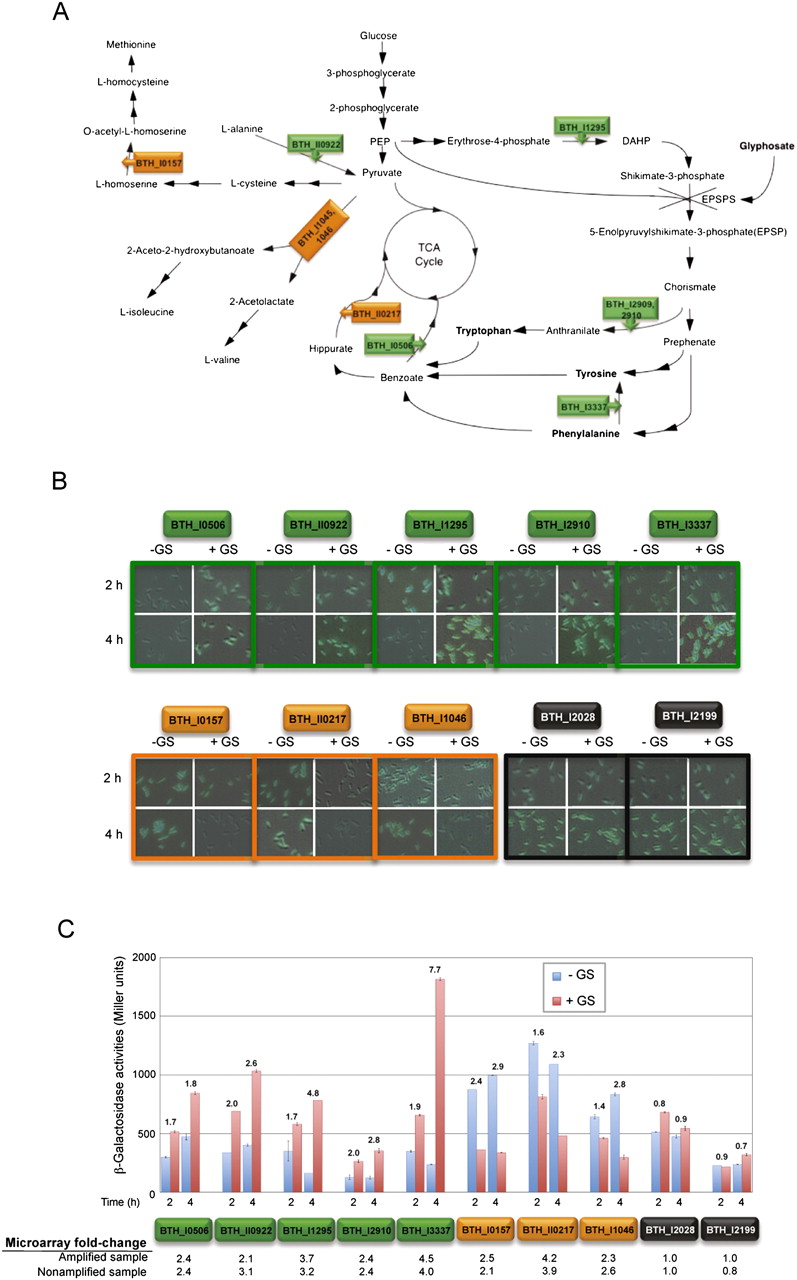
Validation of microarray data via reporter-gene fusions. (A) Proposed amino acid metabolism pathways influenced by glyphosate (GS) in B. thailandensis. Two connecting arrows indicate two or more reaction steps. The target for GS is 5-enolpyruvylshikimate-3-phosphate synthase (EPSPS) (Fischer et al. 1986). In A, B, and C, green and orange boxes indicate genes induced and repressed, respectively, by GS. (B,C) gfp and lacZ reporters were fused to five GS-induced genes, three GS-repressed genes, and two GS-insensitive control genes (housekeeping gene controls in black boxes). (B) Cells were examined under 630 × magnification at 2 and 4 h post-exposure to GS. Differential interference contrast (DIC) and green fluorescence images were merged, and the representative fields are shown. (C) At the same time points, β-galactosidase activities for these fusion strains were determined in triplicate, and the Miller units were plotted with the SEM. The numbers above the bars in the histogram in C indicate fold-induction or fold-repression differences by GS, as measured by β-galactosidase assays. For comparison, the microarray data fold-change of the corresponding genes from the amplified sample and the nonamplified sample are also displayed below the graph. As a general trend, these gene-fusion data agree with the microarray data at both 2 and 4 h post-GS-exposure.



