


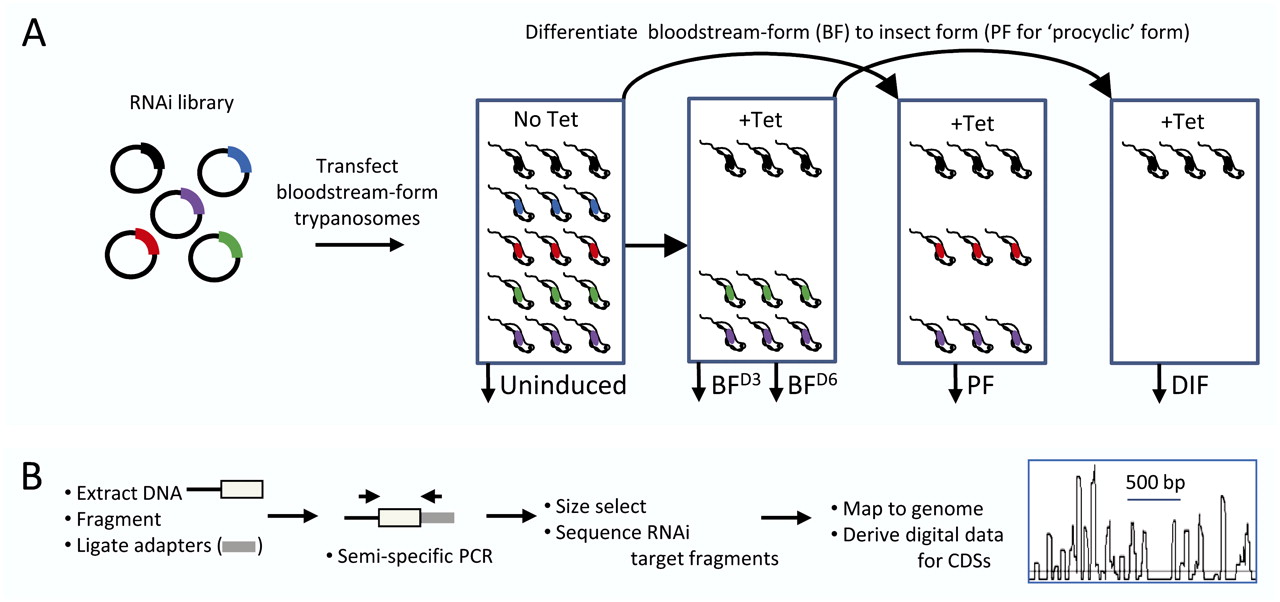
Figure 2.
RIT-seq. (A) Schematic of the RNAi library and the growth conditions analyzed. The RNAi target fragment provides a unique identifier for each cell and its progeny, while dsRNA production is induced by tetracycline (Tet) addition (Fig. 1). Five different possible outcomes are illustrated. (B) Schematic of amplification, sequencing, and mapping of the RNAi target fragments. Only sequences containing a terminal RNAi-vector junction sequence, GCCTCGCGA, were mapped. The box shows a sample region with sequence mapping frequency viewed in Artemis (Carver et al. 2008); each peak represents a unique RNAi target fragment.



