


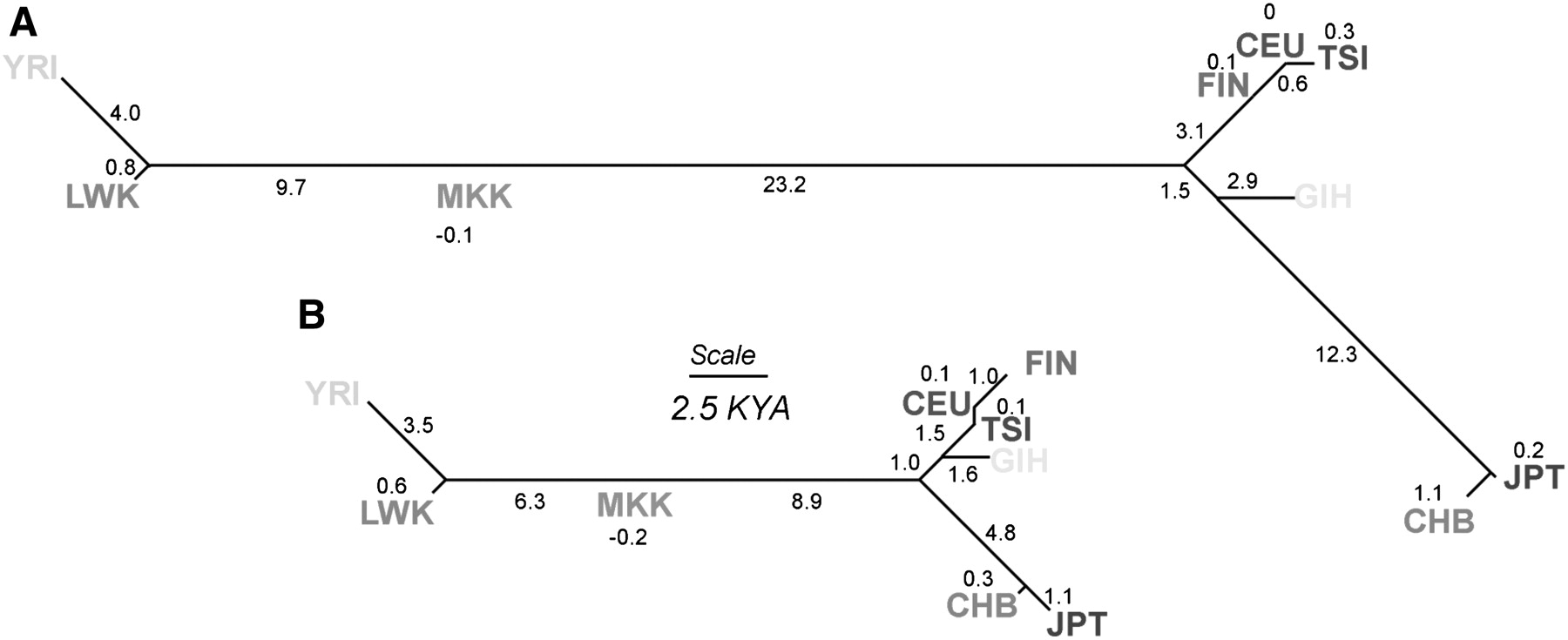
Unrooted neighbor-joining (NJ) networks illustrating (A) TF and (B) TLD divergence times. TF and TLD are estimated using information from genetic distance classes ≤0.10 cM. Branch lengths are proportional to divergence times in thousands of years ago (KYA) with actual values reported along each branch or over the population name where the branch length is too small for labeling. To maintain the additivity of distances along the tree, the NJ method can introduce negative branch lengths by chance. Divergence times between six Northern European (NET, UK, AUS, DEN, SWE, and CEU) and two Chinese (CHD and CHB) population samples were very small (less than 10 generations) for both TF and TLD, suggesting that they are very similar populations in relative global terms. We therefore included only one representative of each set of populations (CEU and CHB for Northwest Europe and China, respectively) in the construction of the NJ tree. We also did not include the Mexican (MEX) and African-Americans (ASW) samples in NJ construction since they are known to be a product of recent admixture between different continental parental populations (see Supplemental Fig. 4). Neighbor-joining trees were generated using the PHYLIP package (version 3.68 available at http://evolution.genetics.washington.edu/phylip.html).



