


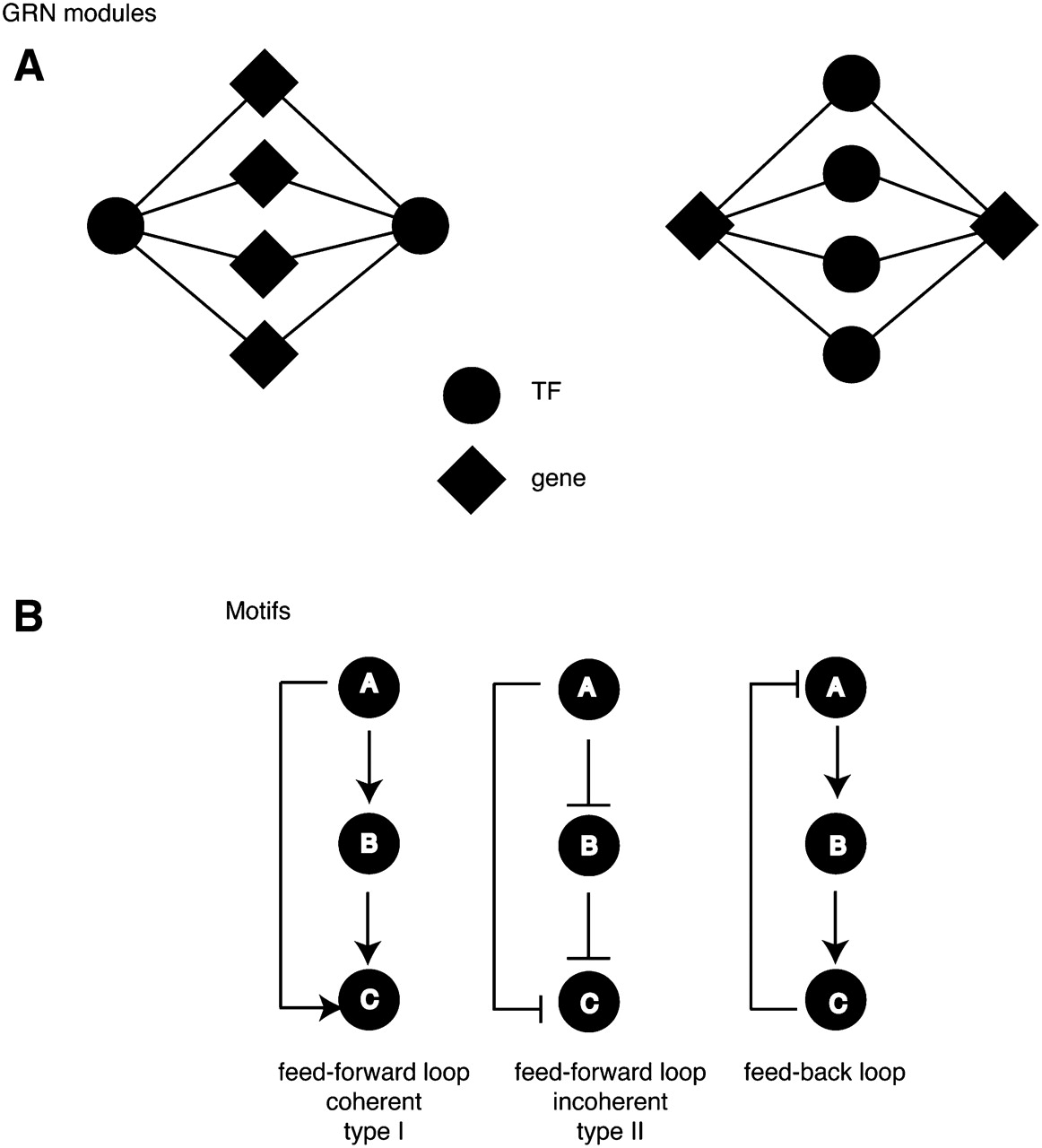
Common network architectures in GRNs. Examples of modules and motifs are shown. (A) GRN modules. (Left) A TF module; (right) a gene module. (B) GRN motifs. A, B, and C represent three genes that interact in a GRN. FFLs can be divided into two types—coherent and incoherent. In coherent FFLs, the effects of A on C from direct and indirect paths are the same. The type I coherent FFL is the most common (shown here), where A activates B and C, and B activates C. In incoherent FFLs, the effects from A on C are opposite. In this type II incoherent FFL, A represses C, and it activates C by repressing the repressor B. (Right) A feedback loop (FBL) is illustrated in which A activates B, B activates C, and the product of C negatively regulates A.



