


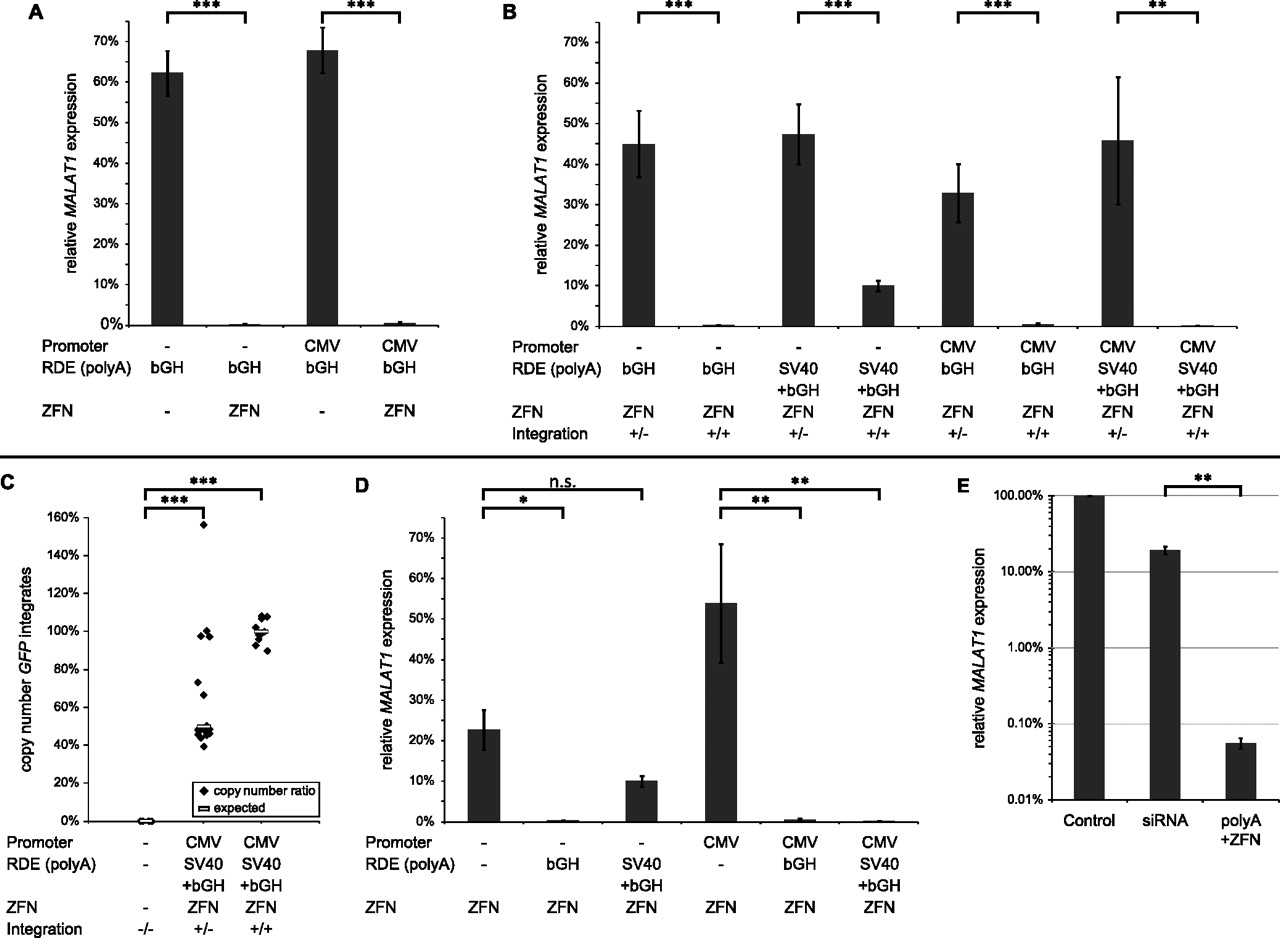
Gene silencing requires ZFN and homozygous poly(A) signal integration and is more effective than siRNA-mediated knockdown. MALAT1 expression levels were determined by Cells-to-CT qRT–PCR of individual clones with RN7SL1 as standardization control. For each group, average expression levels (±SEM) normalized to MALAT1 expression levels in untreated A549 cells (=100%) are shown. The statistical significance of the detected differences was calculated in t-tests; (*) P < 0.05; (**) P < 0.01; (***) P < 0.001. (A) Comparison of the same targeting constructs in the presence or absence of the ZFN. Integration of the poly(A) signal was only observed in the presence of the ZFN, and thus, the MALAT1 expression in clones with homozygous integration was more than 100-fold lower than in clones lacking the ZFN. (B) Comparison of heterozygous and homozygous integration of the poly(A) signal. Homozygous integration of the RDE gave rise to significantly more effective gene silencing. (C) Copy number determination of GFP integration sites in 30 clones. Quantitative RT–PCR of genomic DNA from wild-type, heterozygous, and homozygous clones unraveled the number of GFP integration sites relative to sequences upstream of the MALAT1 locus. The number of GFP integration sites matched the copy number of the control sequence in homozygous clones corroborating the specificity of the integration reaction. (D) Comparison of targeting constructs with and without the silencing element, the poly(A) signal(s). While the integration of GFP without an RDE had only a minor effect on MALAT1 expression, homozygous integration of a poly(A) signal significantly reduced MALAT1 expression with one exception. (E) Comparison between RNA interference and the ZFN-mediated RDE integration. Transfection of the four most effective siRNAs was compared with the four clones with strongest poly(A)-induced gene silencing. MALAT1 knockdown was significantly more than 300-fold stronger in the clones with homozygous poly(A) signal integration.



