


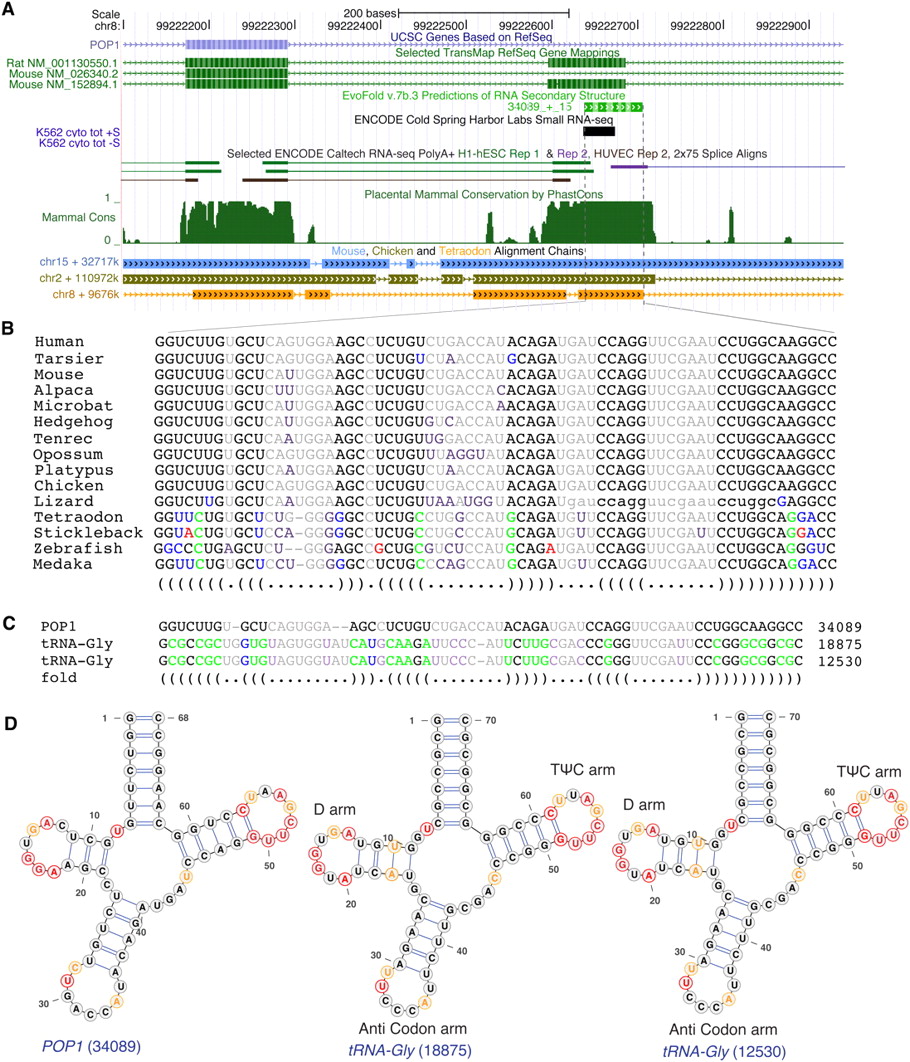
tRNA-like structure in intron of POP1. (A) Intronic location of the structure. The ENCODE CSHL small RNA-seq track (The ENCODE Project Consortium 2007) for cell line K562 represents three uniquely mapped cytoplasmic reads with 5′-ends aligned with the predicted RNase P cleavage site (the cloning protocol generates directional libraries that are read from the 5′-ends of the inserts, which should largely correspond to the 5′-ends of the mature RNA). Spliced reads suggest splicing activity and possible cassette exon in the region of the structure; mapped RefSeqs (TransMap) show cassette exons from mouse and rat that overlap the structure position. (B) Alignment with a subset of species selected to show all observed substitutions (colors as in Fig. 2). (C) Alignment of human sequences of family. (D) Structures of family members with tRNA invariant (red) and semi-invariant (R or Y; orange) nucleotides (Brown 2007) (RNA structure images generated with VARNA [Darty et al. 2009]).



