


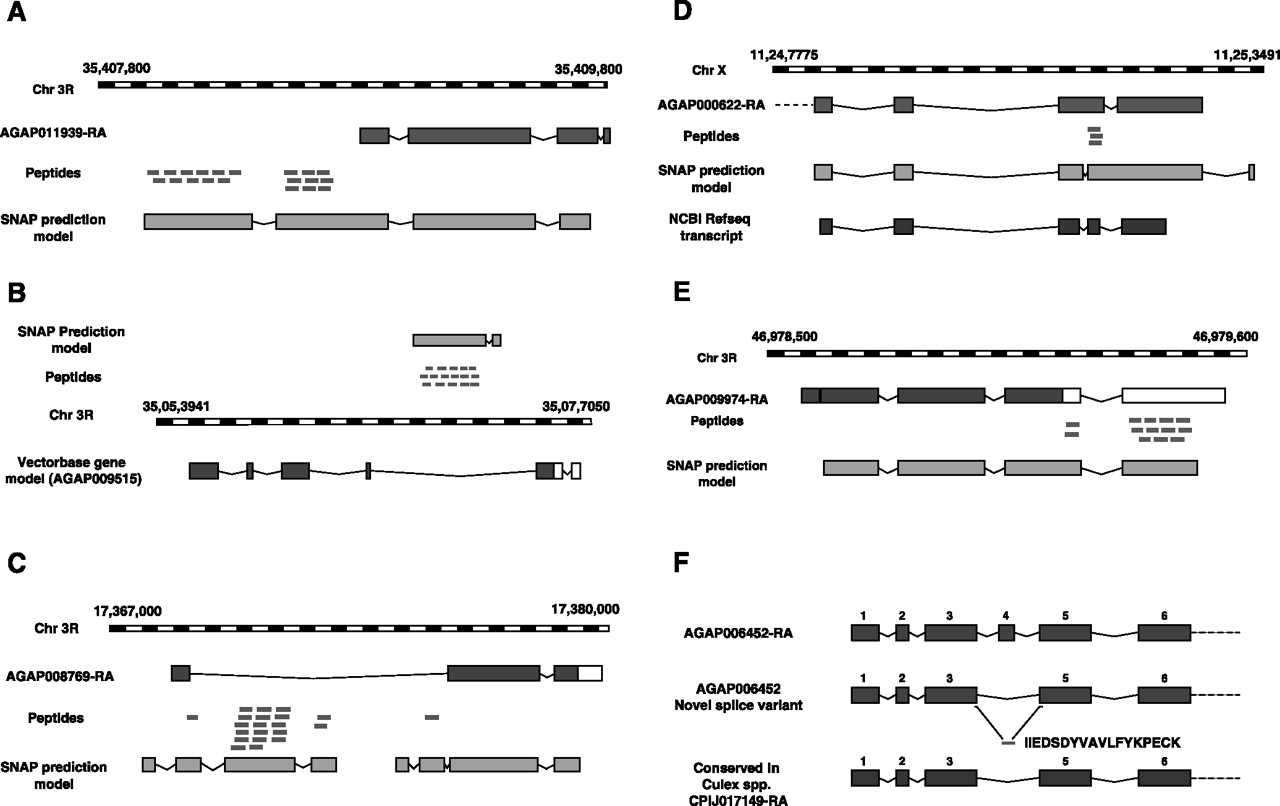
(A) N-terminal extension of AGAP011939 using peptides mapping to an upstream intergenic region. Twenty peptides were mapped to an intergenic region upstream of the gene AGAP011939. SNAP predicts a longer gene model that is supported by novel peptides identified upstream of this gene. (B) Identification of a novel protein-coding gene using peptides mapping to an intergenic region. Sixteen peptides were mapped to an intergenic region on chromosome 3R, where the intron of a VectorBase gene model AGAP009515-RA was annotated on the opposite strand. The presence of a novel gene in this region is also indicated by the SNAP prediction program. (C) Correction of a gene structure using peptide mapping to an intron of an annotated gene. Fifteen peptides were identified in the intronic region of the gene AGAP008769. These peptides support two different gene models predicted by SNAP. (D) Identification of peptides translated in a different frame from the annotated protein sequence. Three GSSPs mapped within the coordinates of the sixth exon of the AGAP000622 gene that were not present in the predicted protein product of the gene. However, these peptides were present in the protein product of SNAP prediction and NCBI RefSeq annotation. (E) Identification of a novel protein-coding region using peptides mapping to the UTR of a gene. Five GSSPs mapped to the 3′-UTR region of the AGAP009974 gene. The SNAP prediction model for this genomic region supports a C-terminal extension of the protein encoded by the AGAP009974 gene. (F) Identification of a novel splice form. The peptide, IIEDSDYVAVLFYKPECK, was identified in the MS/MS ion search against the novel splice junction database of hypothetical splice isoforms. This novel splicing event, which occurred between exons 3 and 5 of the AGAP006452-RA gene, is also observed in Culex quinquefasciatus.



