


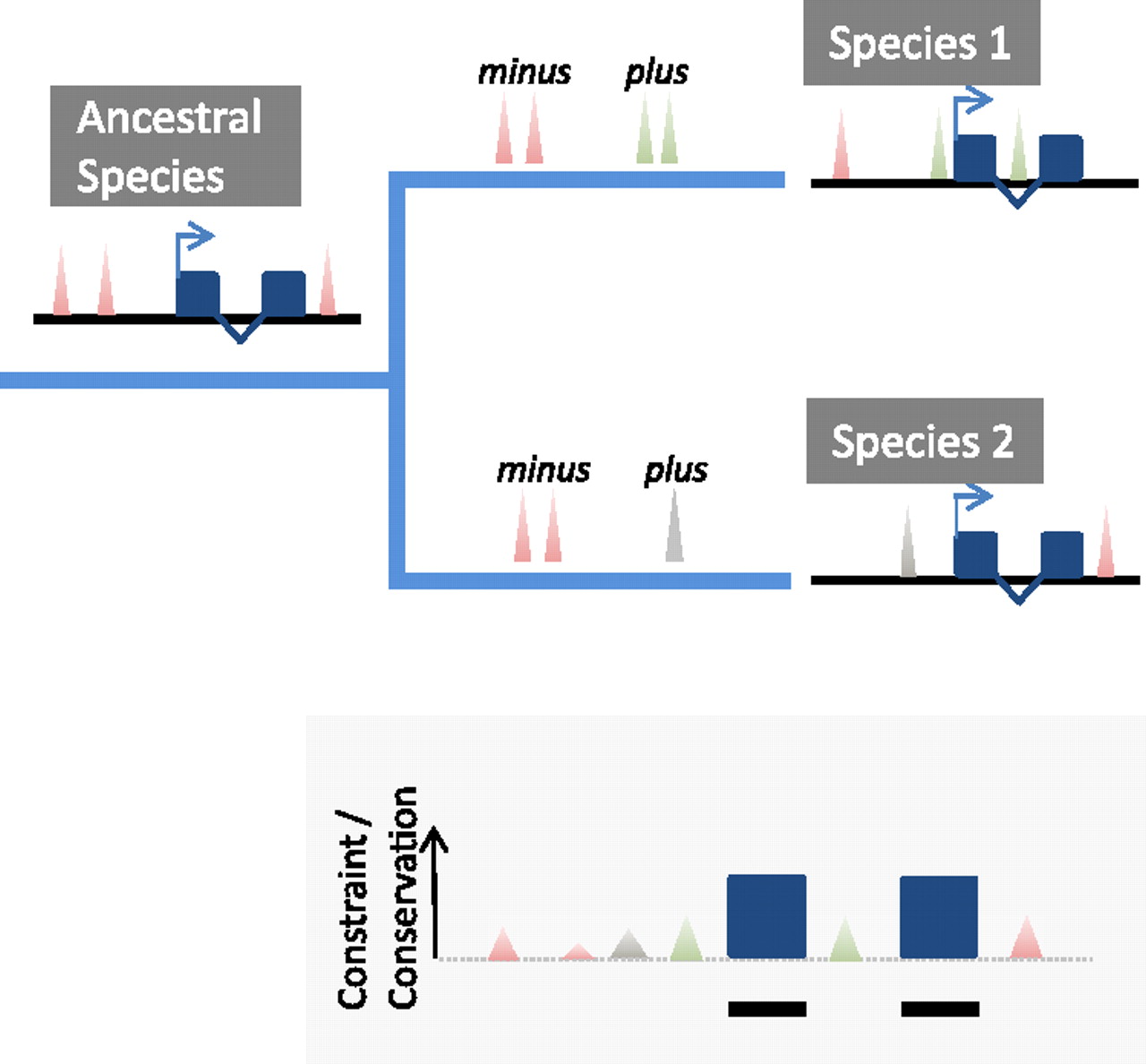
Conservation and turnover of functional sequence. Functional DNA, such as a spliced coding gene (blue) or regulatory elements (red triangles) present in the last common ancestor of two species, may become nonfunctional (minus) or be augmented by newly arisen regulatory sequence (plus) in a lineage-specific manner (green or gray triangles represent such derived functional sequence). Once the orthologous sequence from these two extant species is compared (below), then conservation is strong for retained ancestral functional sequence (here, coding exons, underlined) but is much weaker, and possibly undetectable, for lost ancestral (red) or lineage-specific (green, gray) sequence.



