


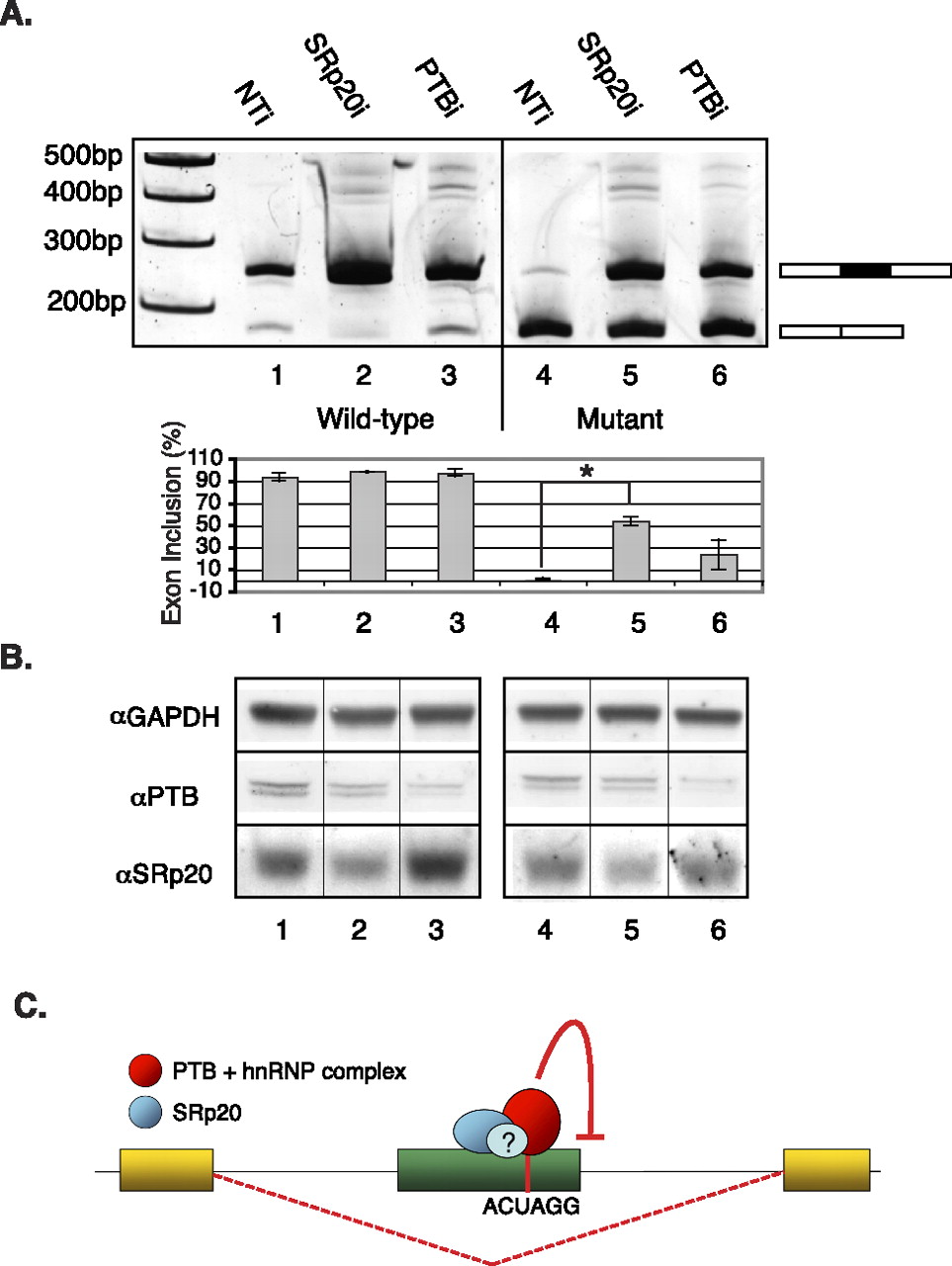
Identification of trans-acting factors implicated in skipping of the ACUAGG-containing OPA1 allele. (A) RT-PCR analysis of OPA1 splicing reporters from HeLa cells cotransfected with non-targeting siRNA (NTi), SRSF3 siRNA (SRp20i), PTBP1 siRNA (PTBi). Lanes 1–3 and 4–6, wild-type and mutant reporters, respectively. Statistical hypothesis testing on means was executed using a Welch t-test for normal data with unequal sample size and variance using α-values of (*) 0.05, (**) 0.01, and (***) 0.001. (B) Western blot showing relative depletion of SRp20 and PTB as compared to the GAPDH loading control. (C) Model for aberrant splicing by “ACUAGG” ESS. A point mutation creating the sequence ACUAGG results in recruitment of a silencer complex that may contain SRp20 and members of the hnRNP protein family, either directly or indirectly bound to the RNA sequence. The complex is involved in deterring inclusion of the mutant exon via mechanism(s) that still remain to be determined.



