


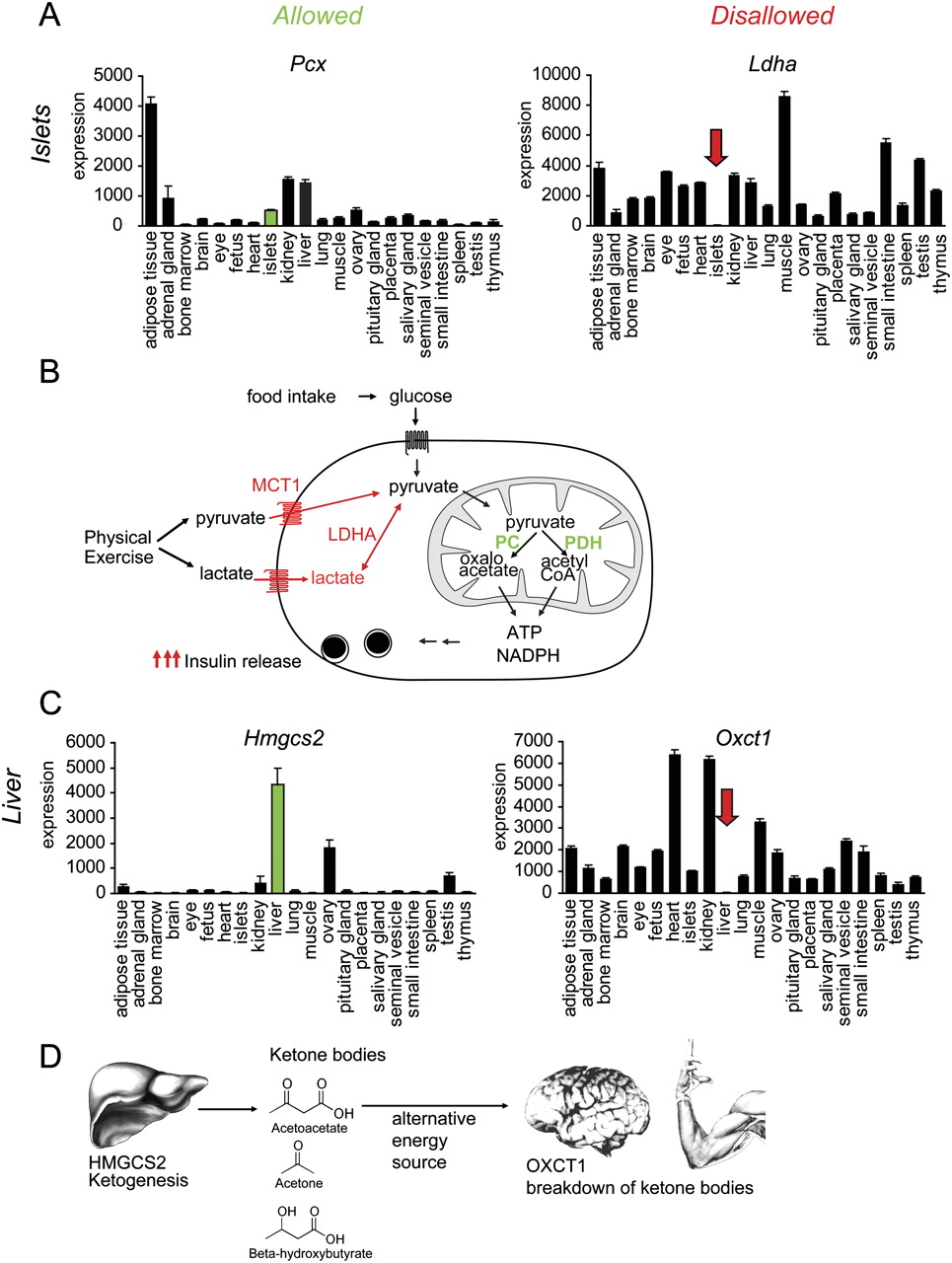
Allowed and disallowed genes. (A) Microarray expression profiles of pyruvate carboxylase (Pcx) versus lactate dehydrogenase A (Ldha), which are, respectively, highly expressed and deeply repressed in adult mouse pancreatic beta-cells. Mean mRNA expression signals ±SEM of three to five biological replicate microarray experiments. (B) Glucose levels in the blood are measured by the beta-cell through conversion of glucose to pyruvate, which is further metabolized in the mitochondria for ATP generation and anaplerosis. Downstream signals lead to insulin secretion. In many other cells, pyruvate does not necessarily come from glucose uptake. Extracellular pyruvate can be directly taken up by monocarboxylate transporter 1 (Mct1), or lactate can be converted to pyruvate by Ldha. However, when this happens in beta-cells, the glucose-sensing mechanism is disrupted, leading to inappropriate insulin release (Otonkoski et al. 2007). (C) Microarray expression profiles of 3-hydroxy 3-methylglutaryl-CoA synthase 2 (Hmgcs2) versus 2-oxoacid CoA transferase (Oxct1), which are, respectively, highly expressed and deeply repressed in adult liver. Mean mRNA expression signals ±SEM of three to five biological replicate microarray experiments. (D) In the fasted state, ketone bodies are generated in the liver. The first and rate-limiting enzyme for ketogenesis is Hmgcs2. Ketone bodies are transported in the blood and can be used by many organs as an alternative energy source. Oxct1 plays a central role in extrahepatic ketone body catabolism by catalyzing the reversible transfer of coenzyme A from succinyl-CoA to acetoacetate.



