


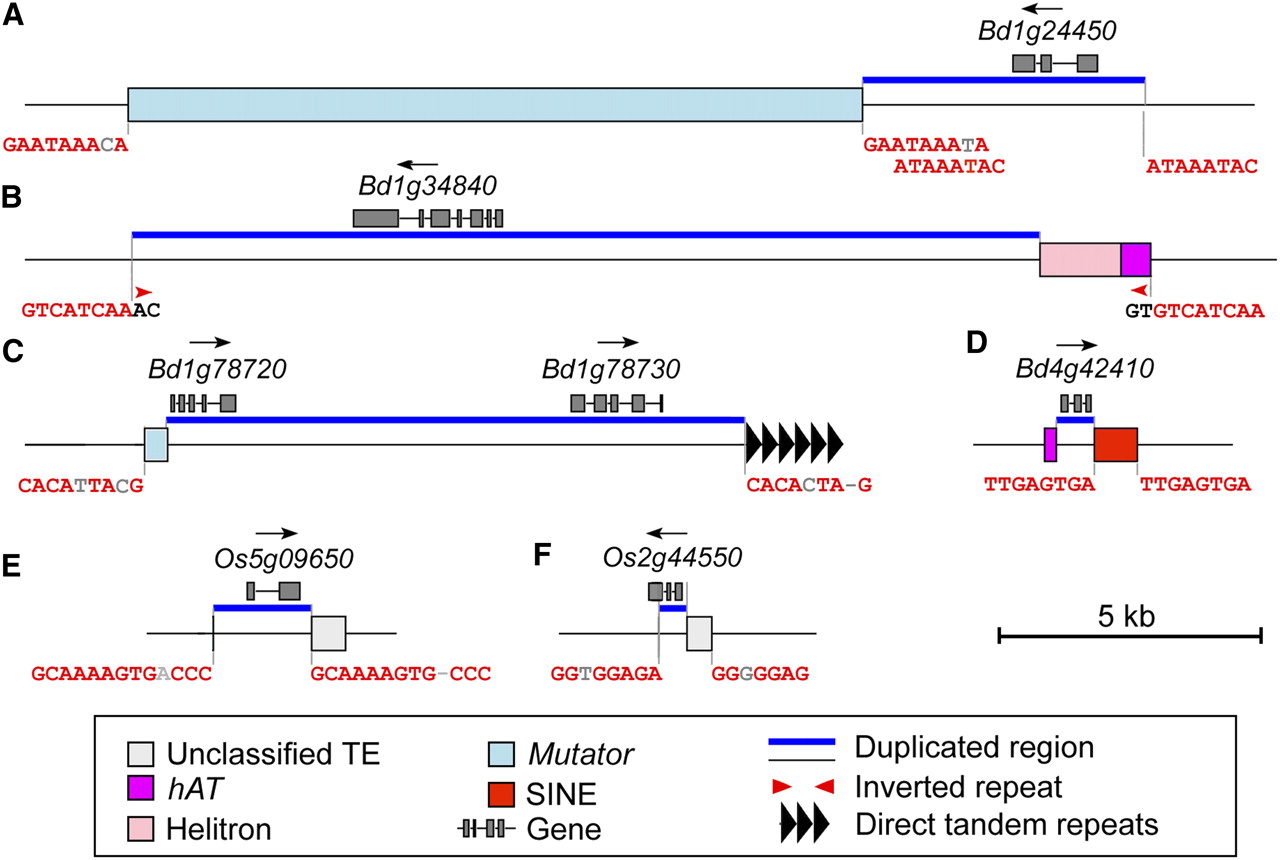
Molecular signatures that point to DSB repair as the cause of gene movement. (Red) Target site duplications (TSDs) that were produced upon the insertion of transposable elements; (gray) mismatches. The double-strand break (DSB) induced by the transposable element insertion occurred within a few base pairs of the terminus of the transposable element. A model for the molecular events that led to the situation in A is given in Figure 6. Depending on the precise location of the DSB, TSDs are flanking the transposable element (C–E), the duplicated region (B,F), or both (A). The example in C is flanked on one side by an array of direct repeats. It is possible that a combination of the TE insertion and the presence of the repeat array lead to the DSB (see also Fig. 5).



