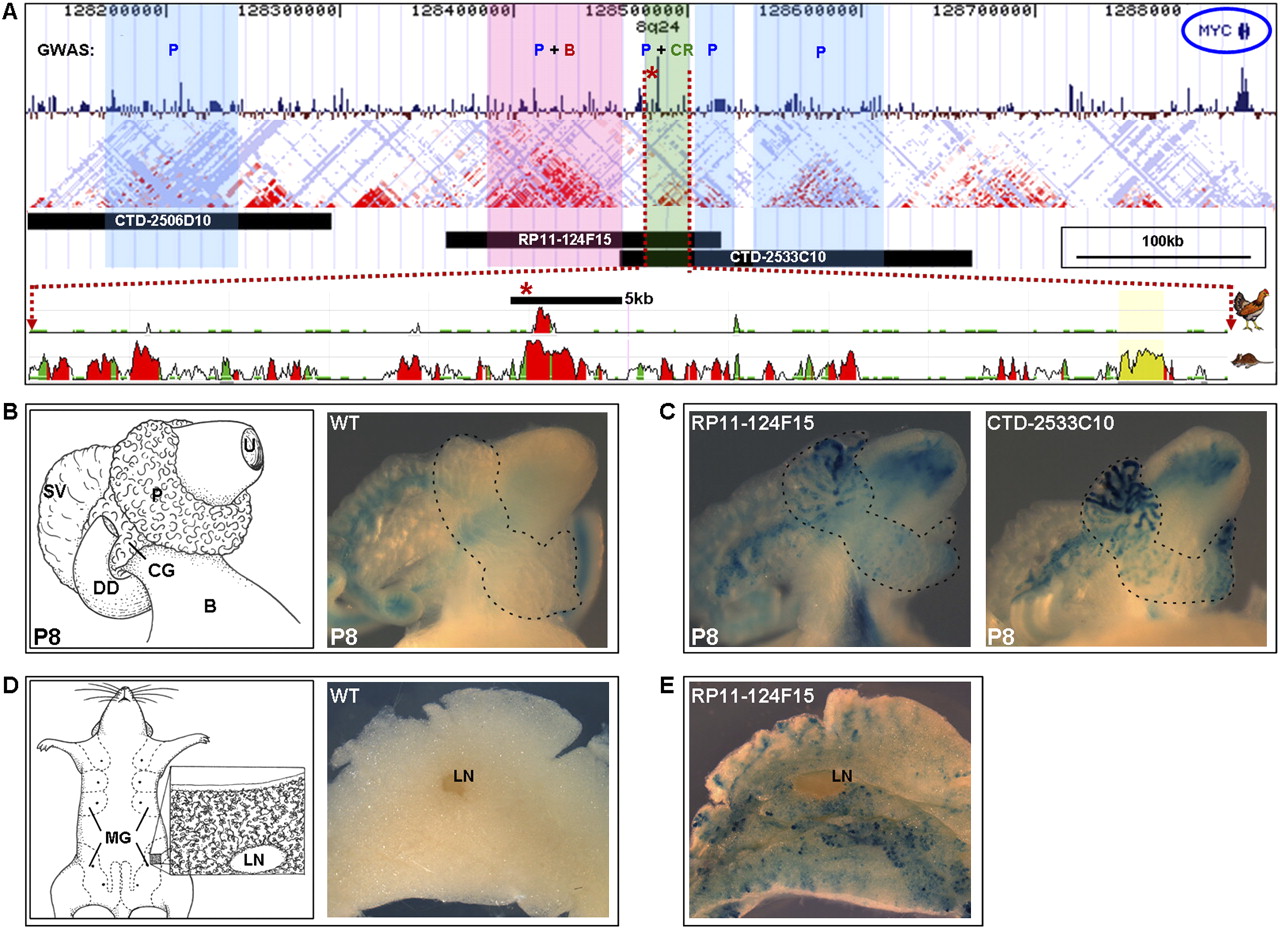
The 8q24 MYC gene desert harbors prostate and mammary gland transcriptional enhancers. (A) Five susceptibility loci within the 440-kb interval shown to be associated with prostate cancer (all shaded regions; blue denotes a prostate-only association), with one locus independently associated with breast cancer (pink) and a second associated with colorectal cancer (green). (B) Breast cancer–associated region, (CR) colorectal cancer–associated region, (P) prostate cancer–associated region. (Blue circle) MYC, (red asterisk) SNP rs6983267. (Below) The three human lacZ-tagged BACs encompassing the prostate cancer risk regions. (Red dotted lines) The LD block containing SNP rs6983267—associated with both prostate and colorectal cancers and contained within BACs RP11-124F15 and CTD-2533C10—is shown in detail. Sequence conservation is shown in chicken and mouse genomes (human genome used as reference). (B) The male genitourinary apparatus in P8 mice, shown as a cartoon (left) and in wild-type, nontransgenic mice (right). (Dashed line, right) Outline of the prostate. (B) Bladder, (CG) coagulating gland, (DD) ductus deferens, (P) prostate, (SV) seminal vesicle, (U) urethra. There is endogenous X-gal staining in the SV and DD. (C) Representative P8 prostates from transgenic mice containing BAC RP11-124F15 or CTD-2533C10 showing prostate and urogenital apparatus enhancer activity. (Dashed lines) Outlines of prostates. (D) The mammary gland in midgestational pregnant females, shown as a cartoon (left) and in wild-type, nontransgenic mice (right). The enlargement (left) illustrates a lymph node, ducts, and alveoli and in a mammary fat pad. (LN) Lymph node, (MG) mammary gland. (E) Representative mammary fat pad from a day 14.5 pregnant female harboring BAC RP11-124F15.