


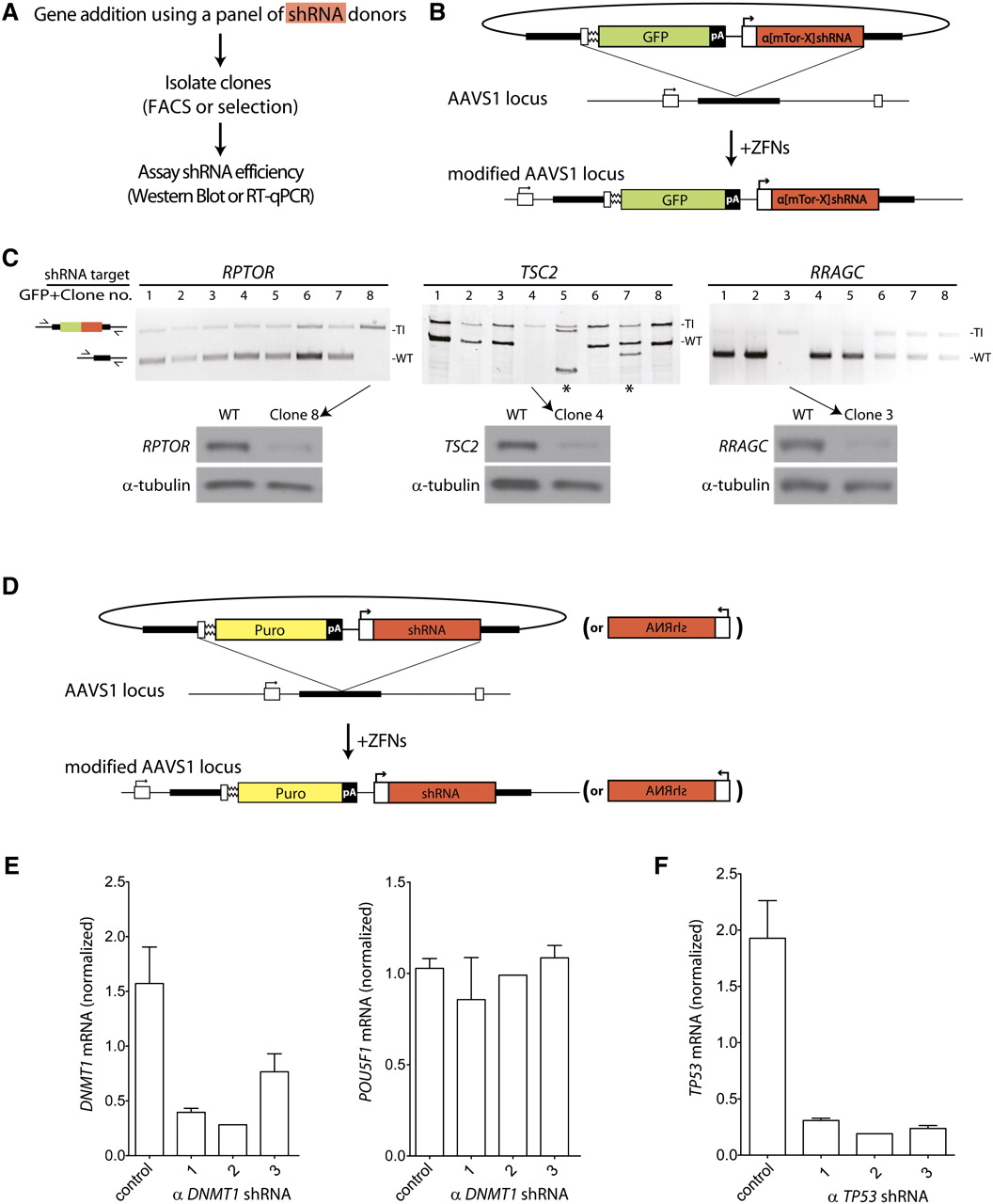
Use of ZFNs to generate a panel of isogenic HEK293 cells and hESCs carrying distinct shRNA expression cassettes at the AAVS1 locus. (A) Experimental outline. (B) Schematic of donor construct for the HEK293 experiment. Gene elements are represented in the same way as in Figure 1B. shRNA cassettes are driven by a pol III promoter, which is annotated as a white box with an arrow, followed by a red box. (C) Genotypes of the AAVS1 locus (top) and protein expression (bottom) of a panel of single-cell derived HEK293 cell clones. The clones were obtained by FACS and genotyped using primers that lie outside the region of homology with the donor construct (schematic of PCR to the left of the autoradiograph). In all cases, the upper band corresponds to the transgenic, and the lower to the wild-type chromatid, respectively. In a small subset of cases (indicated by asterisks), the clone contains an additional allele of the AAVS1 locus, most likely the result of a DSB-induced deletion. The indicated clones were assayed by Western blot (bottom) for levels of proteins encoded by genes targeted by the indicated shRNAs. A Western blot for a loading control (α-tubulin) is shown at the bottom. (D) Schematic overview depicting the editing strategy for adding shRNA expression cassettes to the AAVS1 locus in hES cells. Annotations are as in Figure 1B. (E) Real-time PCR data (normalized to GAPDH mRNA) for DNMT1 (left) or POU5F1 (right) in pools of single-cell-derived hES clones carrying control shRNAs or three distinct shRNAs directed against DNMT1. See Supplemental Figure 8 for Southern blot clone genotyping data. (F) As in panel E, but with TP53 as the shRNA target. Note that in E and F, for shRNA construct no. 2 for each gene target, a single-cell-derived hES clone was analyzed in this experiment.



