


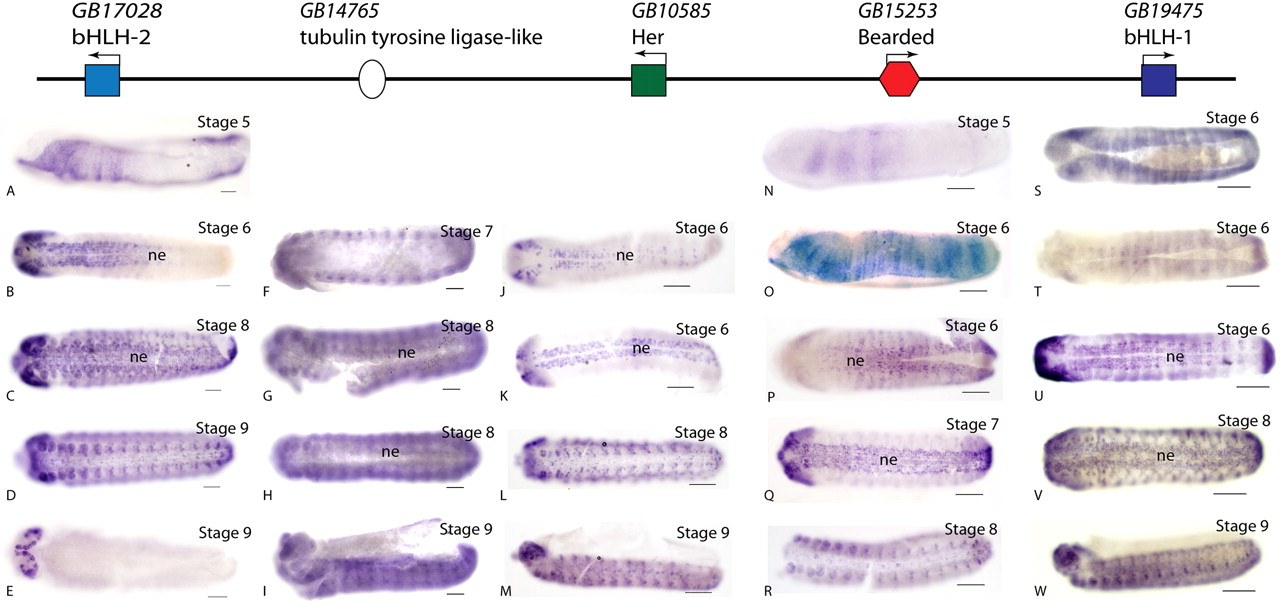
Expression of honeybee E(spl)-C genes. Honeybee embryos stained for E(spl)-C RNA (blue) using in situ hybridization. All embryos are oriented with anterior to the left, and, unless otherwise stated, viewed ventrally. Scale bars, 100 μm. Staging as per DuPraw (1967). (ne) Neurectoderm. (A–E) Expression of GB17028, an E(spl)-C bHLH-2 ortholog. (A) Stage 6 embryo (lateral view). GB17028 RNA is expressed in ectoderm on either side of the gastrulation furrow, in the anterior and in a posterior domain. By late stage 6, after the gastrulation furrow has closed, RNA is present in a complex pattern of cells in the anterior neuroectoderm. This expression spreads from anterior to posterior by stage 7 (B), and by stage 8 (C) RNA is present in a segmentally patterned array of cells throughout the lateral neuroectoderm, and strongly in the developing brain. (D) A stage 9 embryo showing expression in paired domains on either side of the ventral midline, including the gnathal limb buds. (E) A dorsal view of the embryo shown in D. GB17028 RNA is present in the developing brain. (F–I) Expression of GB14765 RNA, a gene that encodes a tubulin tyrosine ligase-like protein. (F) Expression in a stage 7 embryo. GB14765 RNA is present in segmental paired domains at the lateral edge of the germband, probably the tracheal primordia. In stage 8 embryos (G,H [G damaged at the anterior lefthand side]) RNA is present at low levels generally but also in segmental paired domains on either side of the ventral midline. This expression fades in late stage 8 embryos (H). (I) Stage 9 embryo (lateral view) showing expression in segmental stripes, with highest expression at the dorsal edge of the germband in each segment. (J–M) Expression of GB10585 RNA, a honeybee ortholog of Her. In stage 6 embryos (J,K) GB10585 RNA is expressed in the neuroectoderm in a complex pattern of cells with the expression spreading from anterior to posterior, with the entire the pattern extending all the way to the posterior by late stage 6 (K). By stage 8 (L) this expression is lost, and GB10585 RNA is expressed in segmental paired domains on either side of the ventral midline and in the developing brain. (M) Stage 9 embryo, lateral view, showing GB10585 RNA in paired domains on either side of the midline and in patches of cells in each segment at the dorsal edge of the germband, the tracheal primordia. (N–R) Expression of GB15253 RNA, a bearded ortholog. (N) Expression in a stage 5 embryo (lateral view), just before the onset of gastrulation. GB15253 RNA is present in a series of broad stripes in the anterior lateral ectoderm and in a single narrow stripe in the posterior. (O) Stage 6 embryo (lateral view) as gastrulation begins, GB15253 RNA is present broadly in the lateral ectoderm, but expression is modulated in a series of narrow stripes. (P) Late stage 6 embryo (ventral view; embryo damaged in the posterior right side). As the gastrulation furrow closes in the posterior, GB15253 RNA expression is present in broad domains at the edge of the gastrulation furrow, the neuroectoderm; as gastrulation proceeds this broad domain fades, and in anterior to posterior sequence, leaving a complex pattern of cells expressing GB15253 RNA in the neuroectoderm at stage 7 (Q). (R) Stage 8 embryo (anterior regions damaged) showing GB15253 RNA in paired domains on either side of the midline, including in the gnathal limb buds; expression can also be seen in a small number of cells in the ventral midline. (S–W) Expression of GB19475 RNA, an E(spl)-C bHLH-1 orthologous gene. (S) Early stage 6 embryo. GB19475 RNA is present in the lateral ectoderm in broad domains modulated by possible segmental stripes. As the gastrulation furrow closes, in the anterior in this specimen, this domain becomes narrower and focuses down to just the edges of the gastrulation furrow. (T) In mid stage 6 embryos, broad lateral expression has faded, but RNA is becoming expressed in a complex set of cells on either side of the gastrulation furrow, in the neuroectoderm, and in a posterior cap. (U) In late stage 6 embryos this complex neuroectodermal staining stretches the length of the embryo to the posterior cap. (V) Stage 8 embryo. GB19475 RNA is present in a complex pattern of cells in the neuroectoderm and ventral midline. Segmental domains of expression can also be seen in cells at the dorsal edge of the germband. (W) Stage 9 embryo (lateral view) GB19475 RNA is expressed in paired groups of cells on either side of the ventral midline, including the gnathal limb buds, and faintly in the tracheal primordia at the dorsal edge of the germband.



