


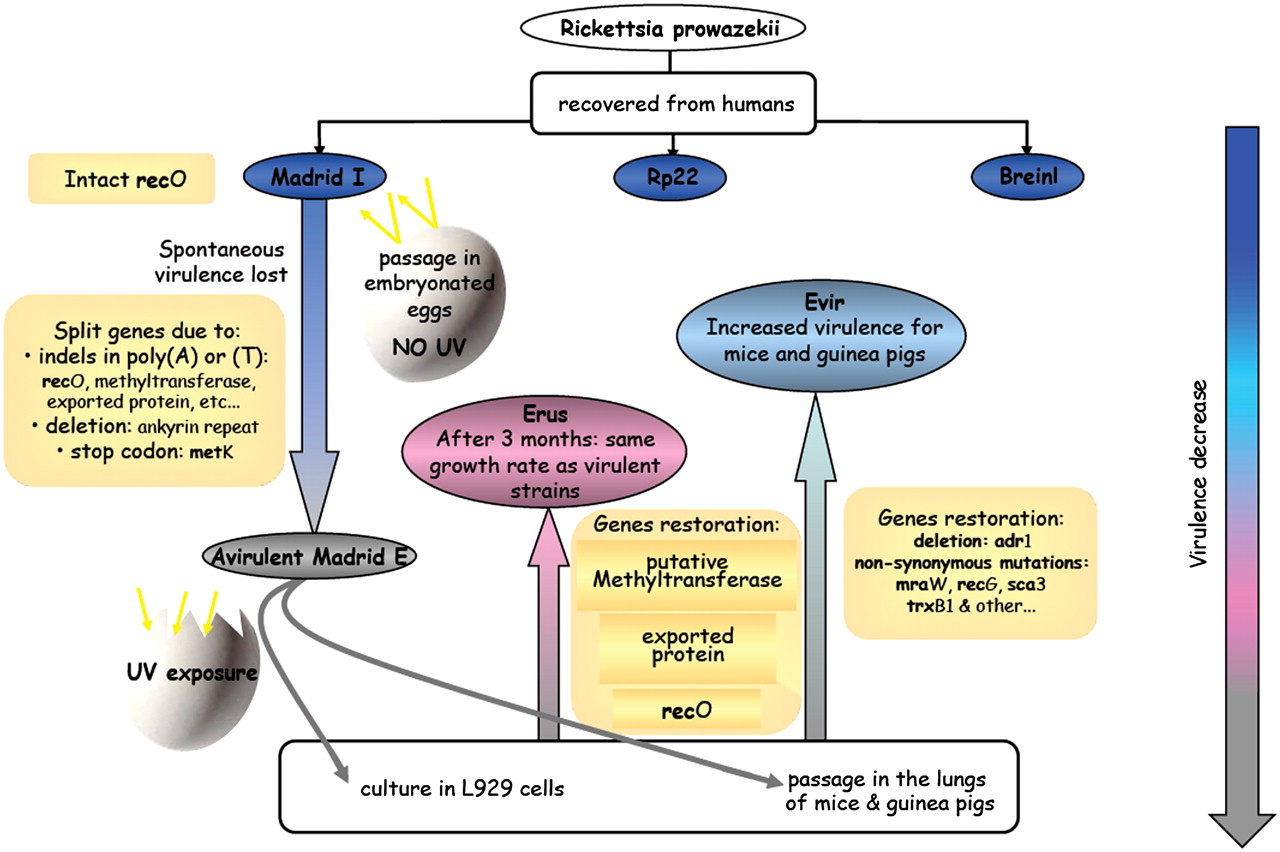
Scheme of R. prowazekii strains origin and evolution. The Breinl strain and the most recent isolate, Rp22, are considered highly virulent. The Madrid I strain was isolated in 1941 during the Madrid outbreak of epidemic typhus. After passages in embryonated eggs, Madrid I has lost its virulence and has been used under the name of Madrid E as a vaccine in humans since 1944. When it was inoculated to small rodents, Madrid E recovered some virulence (Evir). From Madrid E (300–600 passages in eggs), we have recently generated a new isolate by cultivating them in L 929 cells (Erus). (Breinl and Rp22) Virulent for humans and animals and replicates efficiently in L929 cells; (Evir) virulent for animals and replicates efficiently in L929 cells; (Erus) avirulent for animals, but replicates with L929; (Madrid E) avirulent for humans and animals and grows slowly in L929 cells.



