


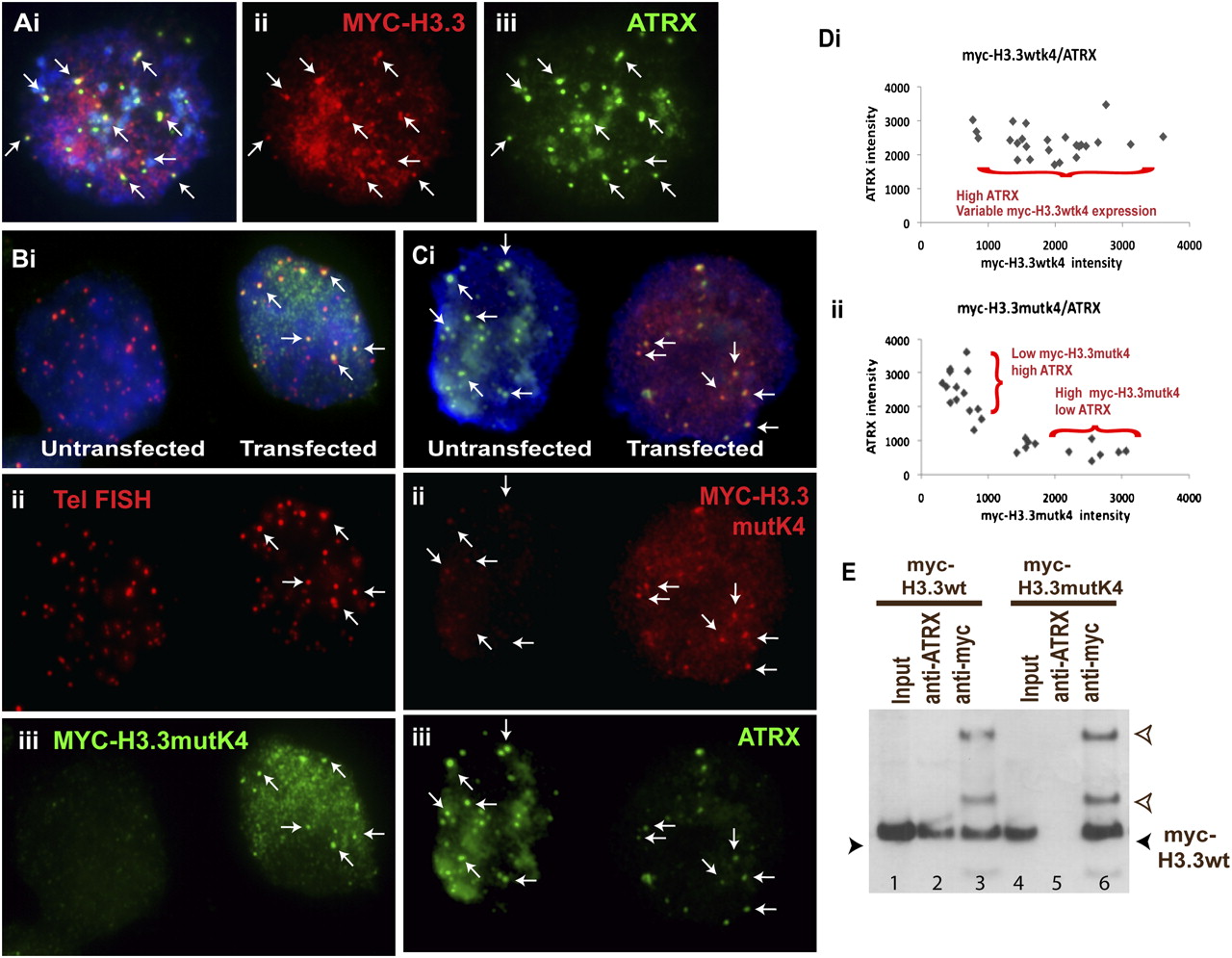
The effects of H3.3 lysine-4 mutation on its interaction with ATRX by immunofluorescence and immunoprecipitation/Western blot analysis. (A) As a positive control, we showed a clear colocalization of MYC-H3.3 (ii, red) with ATRX (iii, green) in ES129.1 cells. (B,C) The mutation of K4 (lysine to alanine) residue was introduced by site-directed PCR mutagenesis. The MYC-H3.3mutK4 plasmid DNA was transiently transfected into mouse ES129.1 cells. The expression of MYC-H3.3mutK4 (Biii, green; indicated by arrows) in ES129.1 cells (cell on the right) did not affect its telomeric localization (as indicated by telomere FISH signals; Bii, red) but resulted in a significant reduction in the association of ATRX (Ciii, green) with MYC-H3.3 (Cii, red; indicated by arrows) at telomeres compared with cells not expressing MYC-H3.3mutK4 (cell on the left). (D) In ES129.1 cells expressing either MYC-H3.3wtK4 or MYC-H3.3mutK4, the signal intensities of MYC-H3.3wtK4/ATRX and MYC-H3.3mutK4/ATRX were quantitated. For each cell, the intensities for five sets of colocalizing MYC-H3.3wtK4/ATRX and MYC-H3.3mutK4/ATRX signals were measured, and the average intensities were determined. In total, 25 cells were assessed (Supplemental Table S3). As shown in the scattered plot, in ES cells expressing MYC-H3.3wtK4, ATRX signal intensity remained high regardless of MYC-H3.3wtK4 signal intensity, whereas, an inverse relationship between the expression level of MYC-H3.3mutK4 and ATRX signal intensity was observed, suggesting that MYC-H3.3mutK4 expression affects ATRX association. (E) Immunoprecipitation with anti-ATRX antiserum pulled down MYC-H3.3 in ES129.1 cells expressing MYC-H3.3 (lane 2) but failed to pull down MYC-H3.3mutK4 in ES129.1 cells expressing MYC-H3.3mutK4 (lane 5). As a positive control, immunoprecipitation with anti-MYC antiserum also pulled down MYC-H3.3 (lane 3) and MYC-H3.3mutK4 (lane 6). The two bands above MYC-H3.3 in lanes 3 and 6 are heavy and light chains of the anti-MYC antiserum (clear arrowheads).



