


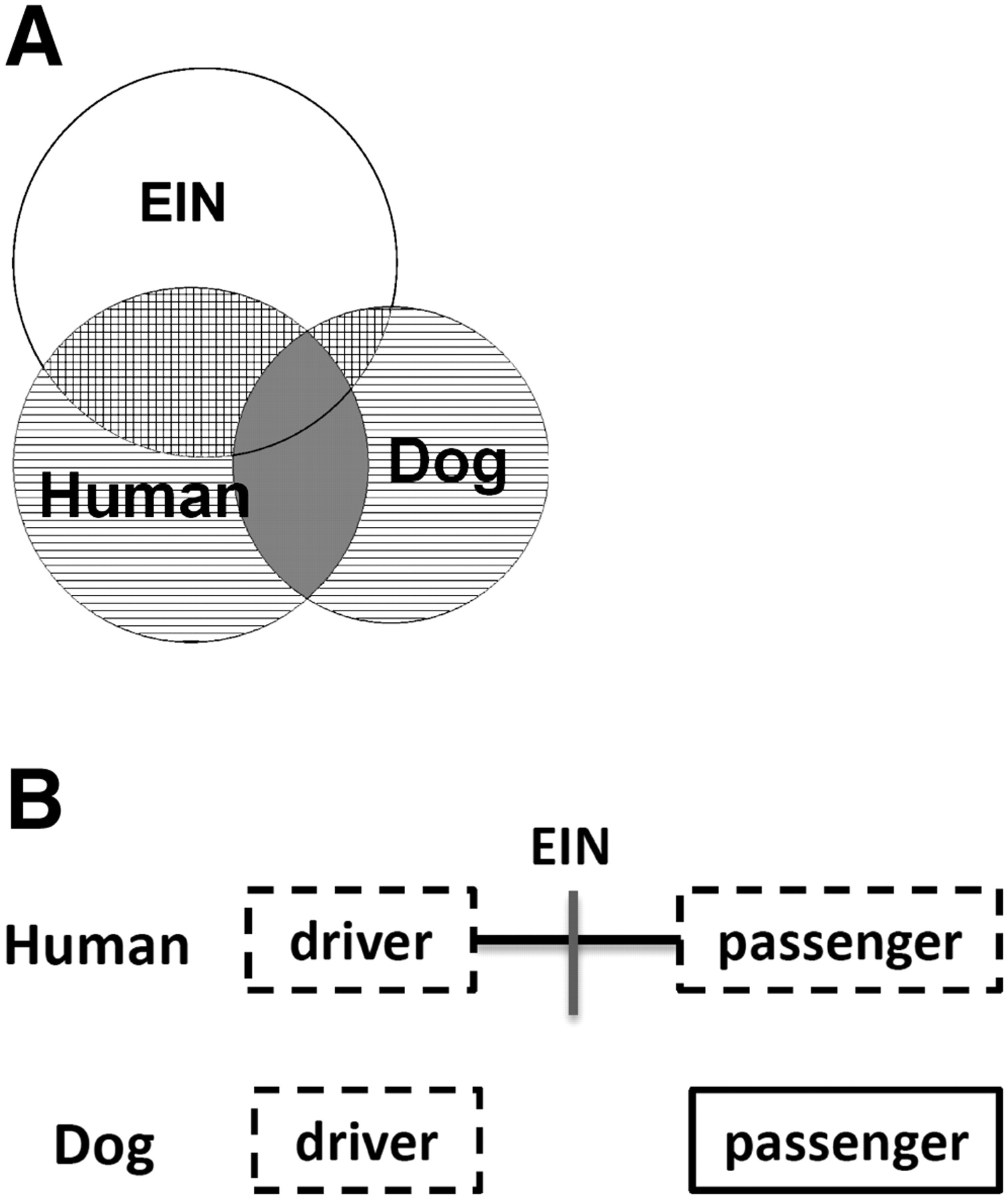
(A) Cross-species comparison for causative (or driver) aberration identification. Once we demonstrate that the same types of cancer from the human and the dog share similar molecular and genetic pathways of cancer development and progression, we will consider abnormalities recurrent between the two species as driver candidates (solid gray area), and those found in only one species and falling in evolutionarily unstable sites (EIN sites) as passenger candidates (small squared areas). Those in the parallel-lined areas need further studies. (B) The advantage of the human–dog comparison strategy over the human-only strategy for cancer driver gene identification. The cross-species comparison strategy can make use of the difference in the genomic location of orthologous genes between the human and the dog, a result of evolutionary genomic rearrangements that occurred since the two species diverged more than 75 million years ago. This shows that two genes, which are nearby in the human genome but distant in the dog genome, are both disrupted in the human cancer (boxed with broken lines). However, in the dog cancer, only one gene is disrupted, which will be considered as driver, and the other is intact (boxed with unbroken lines), which will be deemed as passenger.



