


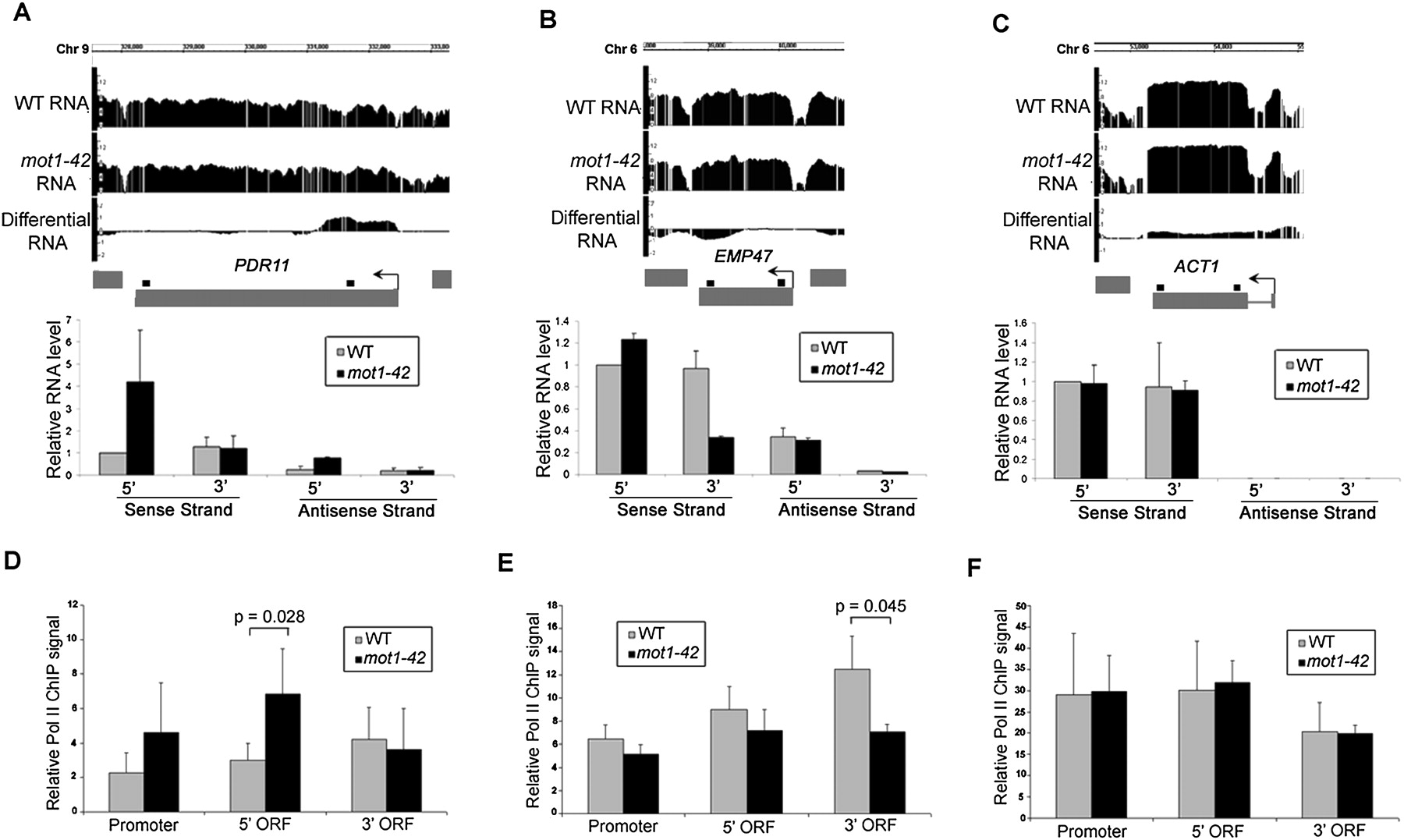
Validation of premature termination RNA length changes in mot1-42 cells and correlation with Pol II density. (A–C, top) Screen shots showing log2 WT, mot1-42, and differential RNA signals across PDR11, EMP47, and ACT1 genes. (Bottom) Relative RNA levels were quantified by real-time PCR for both the sense and antisense strands. Primers were specific for either the 5′ or 3′ end of each gene, and the amplified product is represented by the small black square above each gene. Results shown are from the means of two independent RNA samples with associated SE. PDR11 is an example of a gene with increased 5′ transcription in mot1-42 cells (classified as differentially up), whereas EMP47 had similar levels of 5′ RNA but less 3′ RNA in mot1-42 versus WT cells (classified as differentially down). No RNA length change was detected for ACT1, and the change in RNA level across the open reading frame was small (≤5%) in comparison to the total level of total ACT1 RNA in both strains. Antisense ACT1 RNA was not detectable. (D–F) Relative Pol II ChIP signals in the promoter, 5′ end, and 3′ end of each ORF. The results were obtained using the 8WG16 antibody and are shown as the mean of three independent biological replicates ± SD. The indicated P-values were determined using a one-tailed paired t-test of the log-transformed ChIP values. Note the correspondence between the changes in Pol II ChIP and RNA length changes: The 5′ ORF of PDR11 had an increased level of Pol II in mot1-42 cells that corresponded with increased 5′ ORF RNA level. Similarly, Pol II ChIP signal was decreased in the 3′ ORF of EMP47, consistent with the decrease in 3′ RNA in mot1-42 cells. As expected, there were no significant changes in Pol II ChIP for ACT1.



